
 By istorija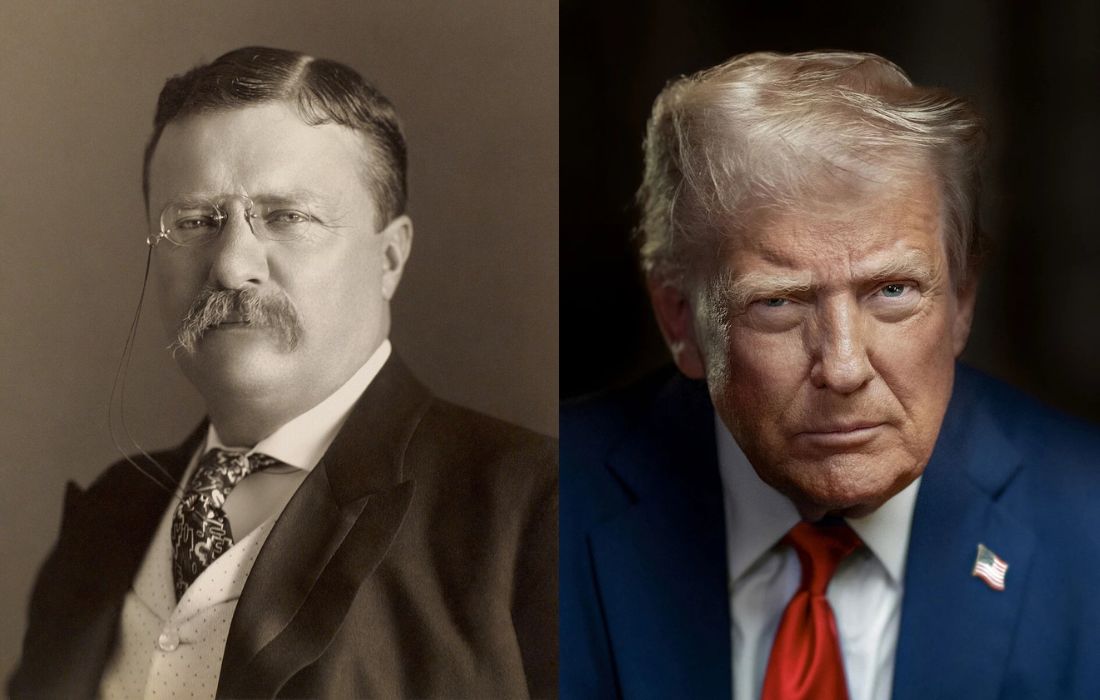
A short video clip recently circulated online showing Donald Trump, the current President of the United States, with a portrait of Theodore Roosevelt positioned prominently above him. The visual juxtaposition was striking: two larger-than-life American presidents, separated by more than a hundred years, yet seemingly connected by a similar philosophy of national strength and focus on American interests.
The comparison is not accidental. Theodore Roosevelt, the 26th President of the United States (1901–1909), embodied a bold, assertive vision of American power. Many of his ideas — putting American interests first, building military strength, and focusing on the Western Hemisphere — carry clear echoes in today’s political debates. But how accurate is this parallel, and what exactly did Roosevelt stand for?
Theodore Roosevelt: The Man and His Vision
Theodore Roosevelt was one of the most dynamic and influential presidents in American history. A war hero, conservationist, trust-buster, and Nobel Peace Prize winner, he dramatically expanded the power and global reach of the American presidency.
Roosevelt strongly believed in American strength and self-reliance. He famously declared: “Speak softly and carry a big stick.” This philosophy combined diplomatic engagement with the willingness to use military power when necessary. He modernized the U.S. Navy, sent the “Great White Fleet” around the world to demonstrate American power, and intervened actively in Latin America and the Caribbean.
He was a firm proponent of the Monroe Doctrine, the 19th-century policy that warned European powers against further colonization or interference in the Western Hemisphere. Roosevelt went even further with his Roosevelt Corollary (1904), which stated that the United States had the right — and the duty — to intervene in Latin American countries if they became unstable or unable to manage their own affairs. In practice, this meant the U.S. would act as a regional policeman to protect American economic and strategic interests.
Roosevelt was deeply patriotic and believed America should prioritize its own development and security. While he supported a strong international role for the United States, his focus remained on building American power on the American continent and projecting strength outward only when it directly served U.S. interests.
He was not an isolationist in the strict sense. He believed America should be strong and respected on the world stage, but he was wary of being drawn into endless European conflicts. His approach can best be described as realist nationalism — putting American interests first while recognizing the need for strategic engagement.
Connection to Today’s “America First”
When Donald Trump campaigned under the slogan “America First”, many commentators immediately drew parallels with Theodore Roosevelt’s assertive nationalism. Both leaders emphasized:
- Prioritizing American workers and industry
- Strengthening military power
- Skepticism toward certain international entanglements
- A belief that America should not be the world’s policeman without clear benefit to itself
However, important differences exist. Roosevelt was an expansionist who believed in American civilizational progress and actively projected power abroad (Panama Canal, Philippines, Caribbean interventions). Trump’s version of “America First” has been more focused on reducing overseas commitments, renegotiating trade deals, and bringing manufacturing jobs back home.
Final Reflection
The visual pairing of Donald Trump with Theodore Roosevelt captures a recurring theme in American politics: the tension between engagement with the world and the instinct to put American interests and sovereignty first. Roosevelt believed America should be strong enough to shape events in its hemisphere and beyond. Today’s debates about “America First” reflect similar instincts, adapted to a very different global landscape.
Whether one agrees with Roosevelt’s methods or not, his presidency reminds us that assertive nationalism has deep roots in American history — long before the 21st century.
Currently Reading
Historical Challenge: Can You Conquer the Past?
Answer more than 18 questions correctly, and you will win a copy of History Chronicles Magazine Vol 1! Take our interactive history quiz now and put your knowledge to the test!