
 By istorija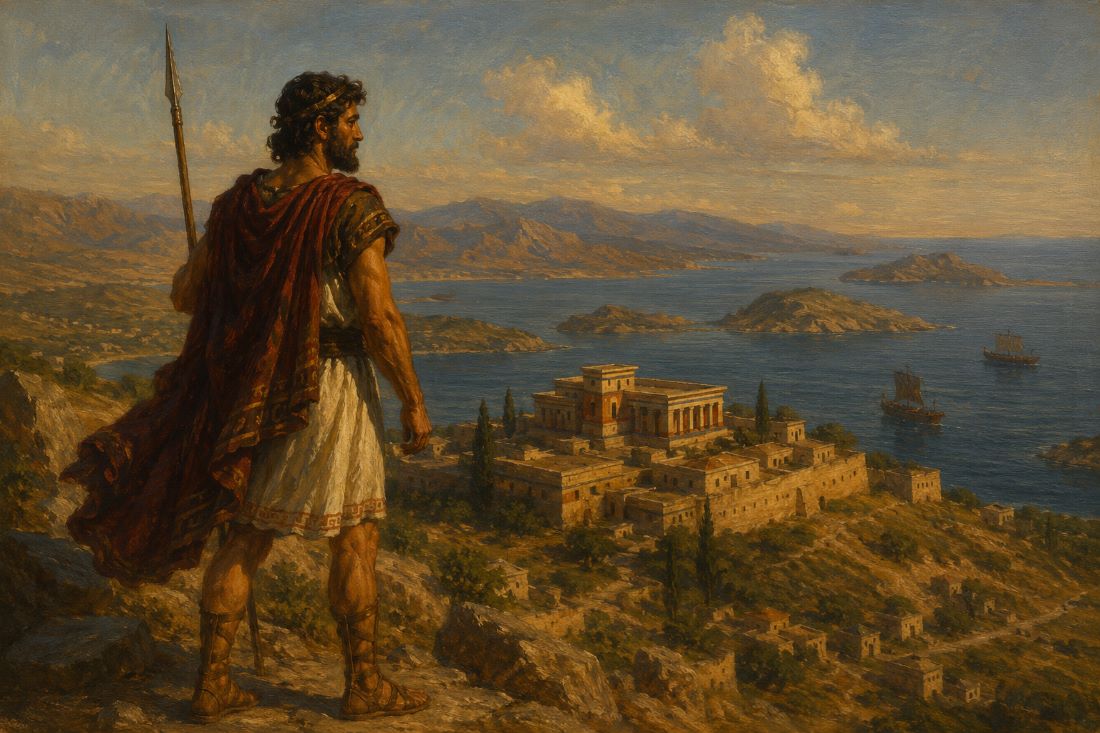
For nearly 3,000 years, people have asked the same question: was Odysseus—the cunning, wide-wandering King of Ithaca—a real man? Was he a flesh-and-blood Mycenaean chieftain, or simply the greatest fictional hero ever created?
With Christopher Nolan bringing The Odyssey back into the global spotlight, millions are once again asking a question that historians, archaeologists, and literary scholars have debated for generations. If you’re wondering whether the man portrayed in Christopher Nolan’s film actually existed, the answer lies at the razor-edge where mythology meets archaeology.
Unlike Achilles, who was celebrated purely for brute force and warrior wrath, Odysseus wasn’t remembered as the strongest man on the battlefield. He survived because he outthought everyone else. He was the master of strategems, the architect of the Trojan Horse, and the ultimate survivor.
But behind the monsters, gods, and epic poetry, is there a real human being buried under the myth?
Who Was Odysseus? The Myth vs. The Mycenaean Warlord
To understand the search for the real Odysseus, we first have to separate the man from the magic. In Homer’s The Odyssey, he is a legendary king who spends ten years fighting at Troy and another ten years struggling to navigate his way home across a sea filled with monsters, nymphs, and vengeful deities.
Strip away the supernatural elements, however, and Homer’s description of Odysseus paints a very specific historical portrait:
-
A Wanax (Chieftain): A regional ruler of a small, rugged island kingdom off the western coast of Greece.
-
A Master Mariner: A skilled navigator capable of leading raids across the Aegean and Mediterranean seas.
-
A Pragmatic Leader: A warrior defined by metis (cunning intelligence) rather than reckless brute strength.
This portrait aligns remarkably well with what we know about the Late Bronze Age (roughly 1600–1100 BCE). This was an era defined by warrior elites who ruled fortified hilltop citadels, controlled maritime trade routes, and launched brutal predatory raids against their neighbors.
Odysseus, as a character, fits the exact profile of a Mycenaean warlord. But did this specific warlord actually exist?
Did Homer Invent Odysseus?
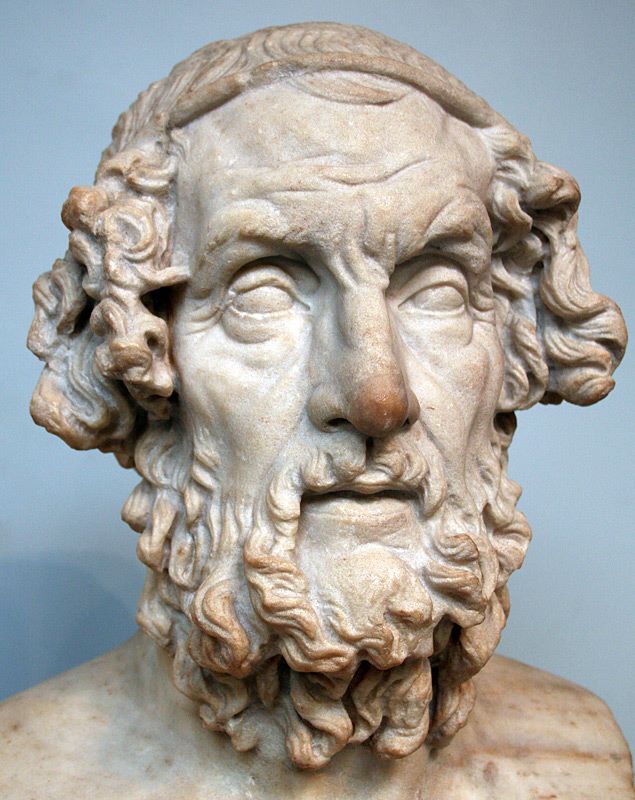
To trace Odysseus, historians must confront his creator: Homer. The Iliad and the Odyssey were composed around the 8th century BCE—nearly four hundred years after the Bronze Age civilization they depict had collapsed.
Homer was not a historian recording strict facts; he was an oral poet synthesizing centuries of spoken traditions.
    [ THE CENTURIES-OLD GAP ]

    c. 1200 BCE: The Fall of Troy / Bronze Age Collapse
         │
         ├── 400 Years of Oral Tradition (Songs, Legends, Myths)
         ▼
    c. 750 BCE: Homer Composes the Odyssey
Because of this massive time gap, 19th-century scholars largely dismissed Homer’s work as pure folklore. They argued that Homer had invented both the Trojan War and its famous heroes out of thin air.
For a long time, the academic consensus was clear: Odysseus was nothing more than a brilliant literary invention.
When Archaeology Challenged the Skeptics
That skepticism was fundamentally challenged in the 1870s thanks to a fanatical German businessman named Heinrich Schliemann. Obsessed with Homer, Schliemann used the Iliad as his literal map, traveled to modern-day Turkey, and began digging at a mound called Hisarlik.
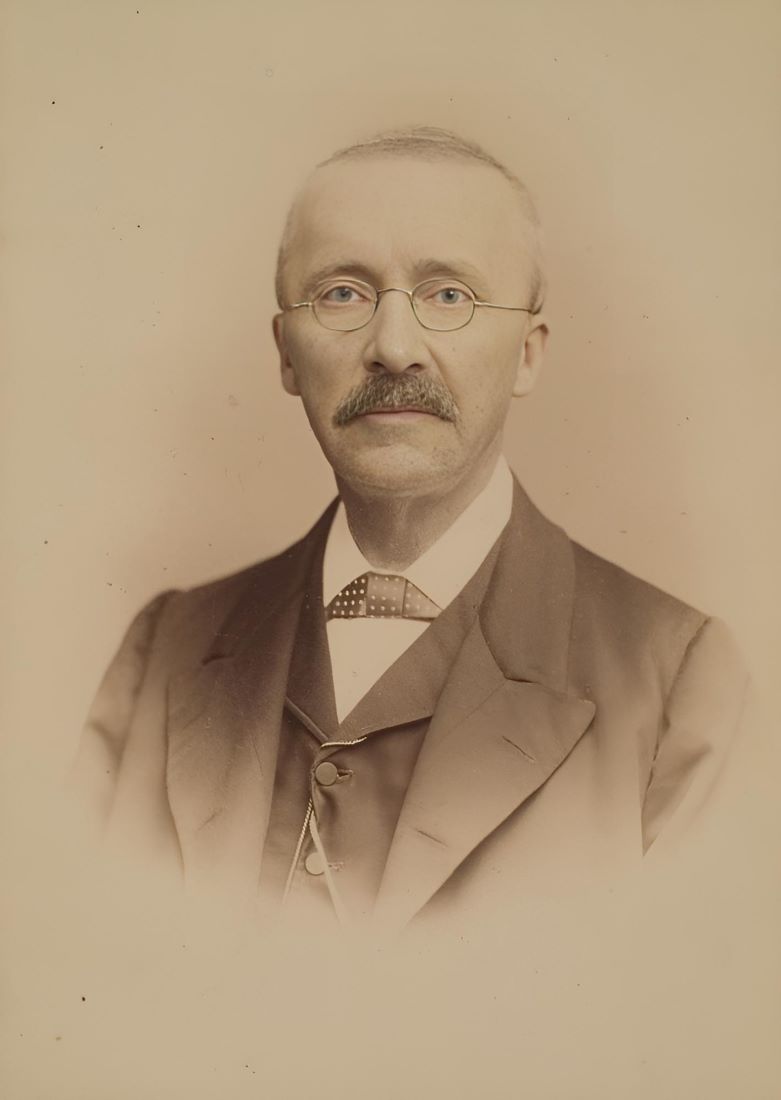
To the astonishment of the world, Schliemann unearthed the massive, burnt ruins of a real Bronze Age city: Troy.
He then crossed over to mainland Greece and excavated Mycenae, uncovering royal shaft graves filled with gold, bronze weapons, and elaborate armor. While Schliemann’s methods were often destructive and his historical conclusions sometimes overstated, he demonstrated that Homer’s epics were deeply rooted in a real Bronze Age world rather than pure fantasy.
This shift changed the nature of the quest. If Troy was real, could the King of Ithaca be real too?
Where Was Ithaca? The Search for Odysseus’ Kingdom
If Odysseus existed, his home island of Ithaca should hold traces of a royal Mycenaean seat. For decades, archaeologists found surprisingly little on the modern island of Ithaki, leading some scholars to theorize that ancient Ithaca was actually located on neighboring Cephalonia.
However, recent archaeological excavations have brought renewed attention back to Ithaki.
At a site called Agios Athanasios (often referred to locally as the “School of Homer”) on modern Ithaki, Greek archaeologists unearthed the ruins of a multi-level Bronze Age palace complex. The site features:
-
Rock-cut staircases and storerooms typical of Mycenaean palace architecture.
-
A 13th-century BCE date stamp, placing its peak right around the traditional timeframe of the Trojan War.
-
A specialized fountain house, which some researchers argue matches specific topographical details described in the Odyssey.
While no inscription reading “Property of Odysseus” has ever been found—and caution is warranted before jumping to conclusions—the discovery proves that a significant Mycenaean seat of power existed on Ithaca during the exact period of the Trojan War.
What Most People Get Wrong About Odysseus
Before diving into the theories, it helps to clear up a few common misconceptions surrounding the hero and his story:
-
❌ “Odysseus has been proven to be a real historical person.”
✔ Reality: No direct written or artifactual proof of his existence has ever been found.
-
❌ “The Trojan War and Troy were completely made up.”
✔ Reality: The city of Troy (Hisarlik) existed, and was destroyed by warfare multiple times during the Late Bronze Age.
-
❌ “The Odyssey is 100% fantasy.”
✔ Reality: While filled with mythical monsters, its geographical routes, social hierarchies, and military tactics reflect genuine Bronze Age reality.
Why Do Historians Still Debate Odysseus?
Despite physical discoveries, the core historical mystery remains unsolved due to one critical missing piece: written contemporary records.
The Mycenaeans kept administrative records using a script called Linear B. Thousands of these clay tablets have been recovered from palaces like Pylos, Knossos, and Mycenae. They list taxes, livestock, weapons, and even names of ordinary citizens and rulers.
Yet, across every tablet translated to date, the name Odysseus never appears as a ruling king.
    [ WHAT THE EVIDENCE TELLS US ]

    Physical Geography  ===> REAL (Troy, Mycenae, and Ithaca palaces exist)
    Bronze Age Culture ===> REAL (Armor, chariots, and raiding tactics match history)
    Direct Written Proof ===> MISSING (No Linear B tablet mentions King Odysseus)
Because direct textual evidence is missing, modern historians generally lean toward two main interpretations:
Theory A: The Composite Hero
Many scholars believe Odysseus was a composite character. Oral poets over centuries took the real-life exploits, shipwrecks, and cunning survival tactics of several historical Mycenaean sea-captains and fused them into a single legendary figure.
Theory B: The Forgotten Warlord
Other historians argue that Odysseus was indeed a real historical king whose small island territory produced fewer clay records—most of which were destroyed during the catastrophic Bronze Age Collapse around 1200 BCE. In this view, his name and reputation survived purely through oral song until Homer immortalized him.
Frequently Asked Questions (FAQ)
Was Odysseus a real person?
We simply do not know for certain. While there is no direct written evidence confirming his existence, archaeology proves that the world he lived in, the city of Troy he fought, and the palace on Ithaca he ruled were all historically real.
Did the Trojan Horse actually exist?
There is no scholarly consensus on this issue. While popular legend depicts a giant wooden horse filled with Greek warriors, many historians argue it was a metaphorical invention or a poetic description of a siege engine (such as a wooden battering ram covered in wet hides) or an earthquake attribute associated with Poseidon.
Did the monsters in The Odyssey have real-life inspirations?
Yes. Many scholars believe the monsters represent real maritime hazards experienced by Bronze Age sailors. For example, Scylla and Charybdis correspond to the dangerous currents and rocky straits of the Strait of Messina between Italy and Sicily.
Conclusion: The Final Truth Written in Stone
We may never find a clay tablet stamped with the seal of Odysseus. We may never know if a single man named Odysseus stood on the walls of Troy, staring out at the Aegean Sea.
Perhaps the greatest discovery is not that Odysseus was a single real person. It is that behind one of humanity’s greatest myths stood a real civilization, a real war, and ordinary men whose stories survived long enough to become immortal.
Currently Reading
Historical Challenge: Can You Conquer the Past?
Answer more than 18 questions correctly, and you will win a copy of History Chronicles Magazine Vol 1! Take our interactive history quiz now and put your knowledge to the test!