
 By istorija
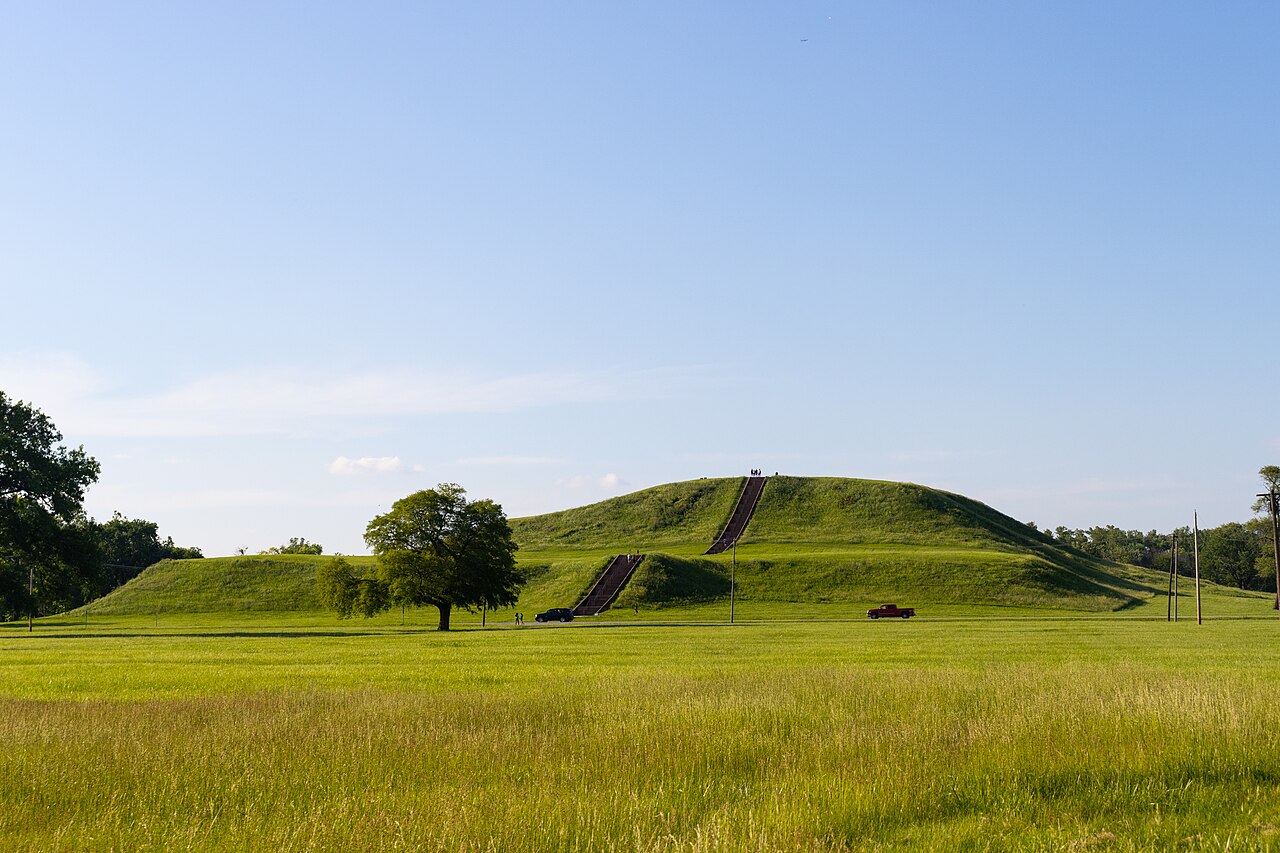
Long before European colonization, a remarkable city flourished beside the Mississippi River in what is now the United States. Cahokia was a major centre of the Mississippian world, with monumental earthen mounds, extensive trade networks, and a population that may have reached tens of thousands. At its height around AD 1100, it rivalled important cities of medieval Europe, challenging the familiar image of pre-Columbian North America as a land of small, isolated communities.
A Forgotten Metropolis of North America
When people think of the great civilizations of pre-Columbian America, the Maya, Aztecs, and Incas usually dominate the discussion. Yet far north of their principal centres, another complex society developed along the Mississippi River.
Cahokia, located in present-day Illinois near modern St. Louis, became the largest urban centre north of Mexico. Its greatest expansion occurred between approximately AD 1050 and 1200, when it emerged as the principal centre of the Mississippian cultural tradition.
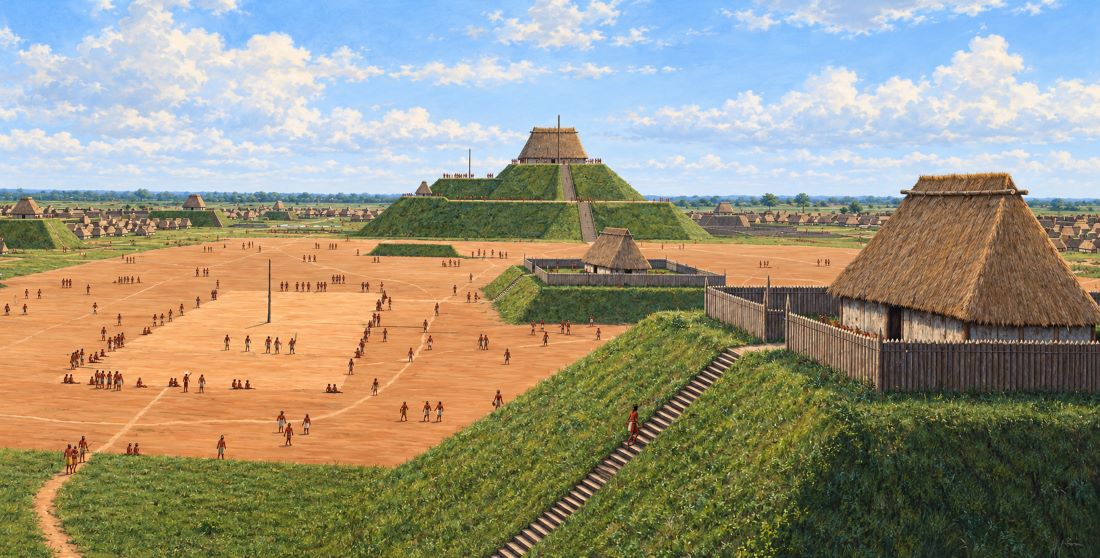
This society developed extensive agricultural systems, monumental architecture, regional political networks, and long-distance exchange. Cahokia was its most impressive urban expression, demonstrating that Indigenous peoples of North America had developed large population centres long before European arrival.
Unlike the stone pyramids of Mesoamerica, Cahokia’s monumental buildings were constructed primarily from earth. Its inhabitants transformed the landscape with enormous artificial mounds, open plazas, wooden structures, and residential neighbourhoods. These features formed a complex urban environment in which political authority, religious ceremonies, and everyday life were closely connected.
The Rise of the Mississippian World
The Mississippian cultural tradition flourished across much of eastern North America from approximately AD 800 to 1500, although individual centres developed along different trajectories. Communities appeared along the Mississippi River and its tributaries, extending from the Great Lakes region towards the Gulf Coast.
Agriculture provided the foundation for their growth. Maize was the principal staple crop, supplemented by beans, squash, and other cultivated plants. Agricultural production supported larger populations and enabled some people to specialize in crafts, religious activities, and political leadership.
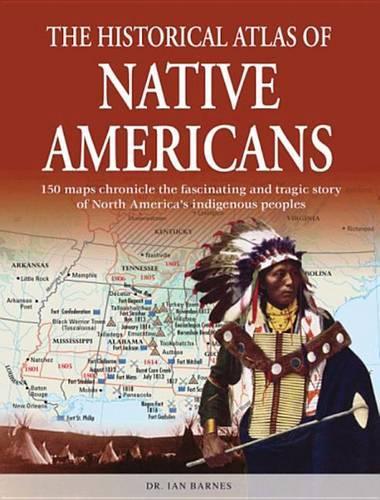
As Ian Barnes explains in The Historical Atlas of Native Americans, Mississippian settlements were often characterized by flat-topped earthen mounds arranged around plazas. Constructing these monuments required substantial collective labour and effective systems of social organization.
Cahokia belonged to a wider network of Mississippian centres, including Moundville in Alabama, Etowah in Georgia, and Spiro in Oklahoma. These communities shared important cultural characteristics but did not constitute a single unified empire.
Cahokia’s exceptional size and monumental landscape distinguished it from other centres, making it an important focal point for understanding the political and cultural development of pre-Columbian North America.
A City Comparable to Medieval European Centres
Cahokia reached its greatest prominence during a period when medieval Europe was also experiencing urban growth. Around AD 1100, London and Paris were established centres of political and economic life, although their populations varied considerably over time.
The population of Cahokia remains debated. The Cahokia Mounds State Historic Site describes a metropolis that may have housed nearly 20,000 people around 1100. Ian Barnes gives a higher estimate of 20,000–40,000 in The Historical Atlas of Native Americans. Such figures should be understood as estimates rather than precise counts, and they may reflect different interpretations of the settlement’s extent.
The distinction between the central settlement and the wider Cahokia region is important. The city formed part of a much larger concentration of communities, agricultural areas, and other settlements in the Mississippi Valley. Estimates can therefore differ depending on which areas are included.
Even conservative estimates establish Cahokia as an exceptional population centre for its time. Its scale invites comparison with important medieval European cities, although it would be misleading to suggest that Cahokia was larger than every European metropolis.
Its significance lies in the fact that a major urban society developed in the interior of North America through a distinctive combination of agriculture, monumental construction, religious institutions, and regional exchange.
Cahokia demonstrates that urbanization did not follow a single universal path. Different societies developed complex centres according to their own environments, resources, and cultural traditions.
Monks Mound: The Monument at the Heart of the City
The most impressive surviving structure at Cahokia is Monks Mound, the largest prehistoric earthen structure in the Americas. It covers approximately six hectares and rises around 30 metres above the surrounding landscape.
The mound was constructed in successive stages, requiring enormous quantities of soil to be collected, transported, and carefully deposited. Its broad terraces supported buildings that may have served political, religious, or ceremonial functions.
Monks Mound dominated the surrounding settlement. Its elevated position distinguished the structures on its summit from ordinary residential areas and gave the city’s central precinct a striking physical presence.
Cahokia contained around 120 earthen mounds, many arranged around open plazas. These spaces provided settings for ceremonies, public gatherings, feasts, and other collective activities. Their arrangement suggests that the city’s monumental core was organized around important social and ceremonial functions.
Another remarkable feature was Woodhenge, a series of circular arrangements of wooden posts associated with observations of the sun. The alignments corresponded to significant points in the solar year, including the solstices, and may have helped inhabitants organize seasonal ceremonies.
Parts of Cahokia’s central settlement were also enclosed by a substantial wooden palisade. Its precise purpose remains uncertain, but it may have served defensive functions or helped regulate access to important areas.
Together, these structures reveal a settlement in which architecture expressed social organization and religious beliefs as well as practical needs.
Power, Religion, and the Mystery of Mound 72
Cahokia’s monumental architecture suggests that its inhabitants belonged to a socially differentiated society. Differences in burials, valuable objects, and access to important spaces indicate that some individuals possessed greater authority and prestige than others.
The precise structure of Cahokia’s political system remains unknown because no contemporary written records describe its rulers or institutions. Archaeologists must reconstruct its social organization from buildings, burials, artefacts, and settlement patterns.
One of the most revealing discoveries is Mound 72, where excavations uncovered the remains of more than 250 people in different burial contexts. Among the most remarkable finds was a burial associated with an extraordinary quantity of marine-shell beads arranged in a bird-shaped design. The central individuals were accompanied by other burials and prestigious objects, including finely made arrowheads and ornaments.
The marine shells had travelled considerable distances to reach Cahokia, providing evidence of extensive exchange networks. The burial arrangements also reveal substantial differences in social status and the importance of ritual practices.
Some groups of individuals buried in Mound 72 are interpreted as victims of ritual killing, possibly sacrificed during ceremonies associated with important individuals. However, the precise circumstances and meanings of these burials remain debated, and newer analyses have challenged earlier interpretations of the principal individuals.
Mound 72 provides a rare glimpse into Cahokia’s social and ceremonial world. It suggests that political authority, ritual, and the treatment of the dead were closely connected, while reminding us that many aspects of Cahokia’s religious beliefs remain uncertain.
Daily Life and Trade Across North America
Behind the monumental centre was a city of ordinary households, agricultural workers, and craftspeople. Most inhabitants lived in houses constructed from wooden posts, woven plant materials, and clay.
Maize formed a major part of the diet, supplemented by beans, squash, wild plants, fish, and game. Agricultural production in the surrounding landscape was essential to sustaining the urban population.
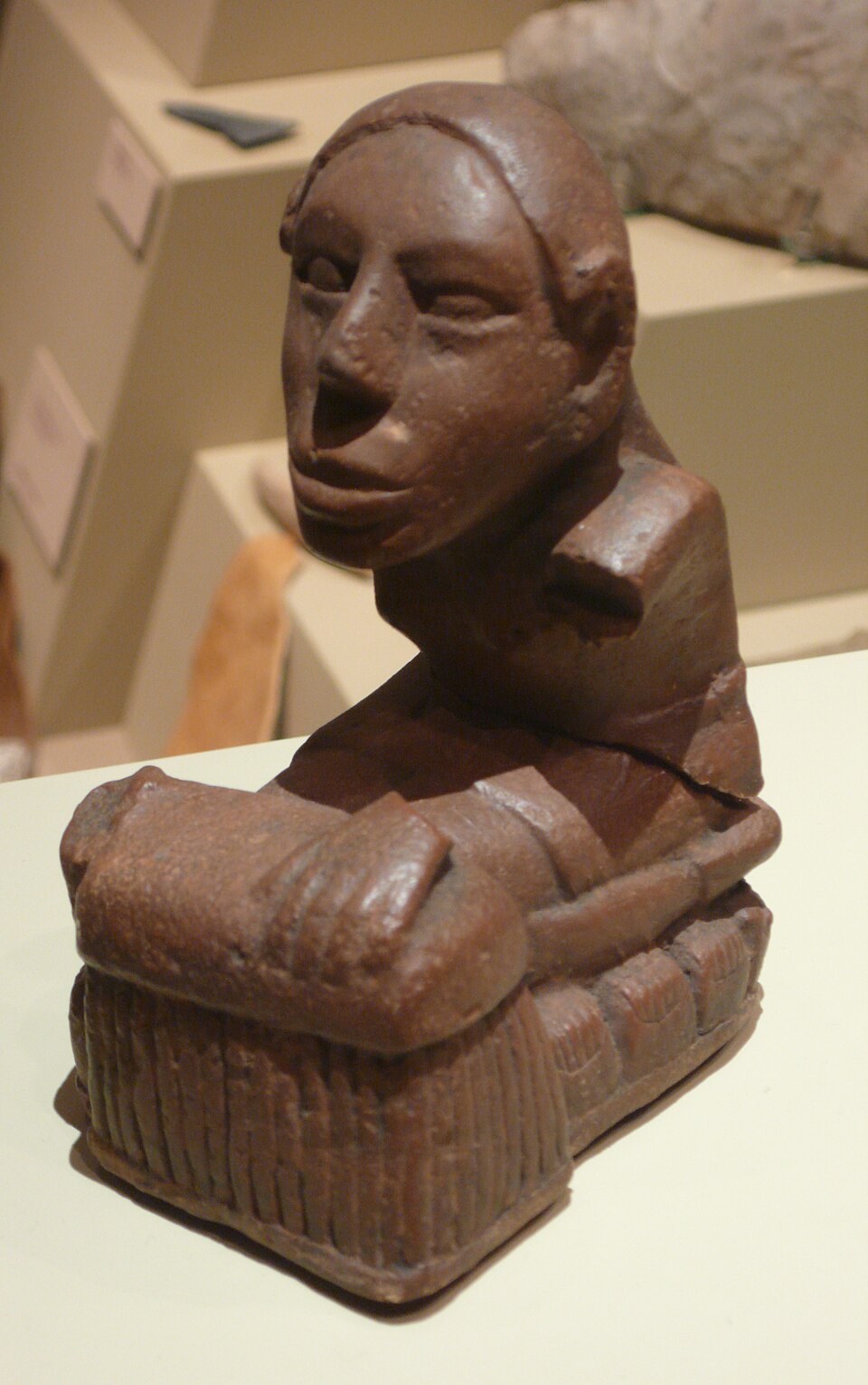
Pottery and stone tools were important in everyday life, while ornaments and other objects could carry social or ceremonial significance. Women played important roles in agricultural production and food processing, although the division of labour within Cahokia cannot be reconstructed in every detail.
The city was also connected to distant regions through an extensive network of exchange. Archaeological discoveries include copper associated with the Great Lakes and Appalachian regions, marine shells from coastal areas, mica, and distinctive varieties of stone.
Rivers provided natural transportation routes, allowing people and goods to move between settlements. These connections carried not only materials but also ideas, artistic styles, and cultural practices.
Cahokia was therefore not an isolated settlement. Its growth was closely connected to the wider Indigenous world of eastern North America, and its influence extended well beyond the immediate Mississippi Valley.
The Decline of Cahokia
After reaching its height between approximately AD 1050 and 1200, Cahokia gradually declined. By the fourteenth century, much of the central settlement had been abandoned.
Archaeologists have proposed several explanations, but no single cause has been universally accepted. Climate variability and drought may have placed pressure on agricultural production, while political instability, environmental change, conflict, and shifting regional relationships may also have contributed.
A study by L. V. Benson, Timothy R. Pauketat, and E. R. Cook, published in American Antiquity in 2009, examined the possible relationship between climate change and Cahokia’s decline. Their research identified drought as a potential source of stress, although climate alone cannot necessarily explain the city’s transformation.
The construction of a substantial palisade around parts of the central settlement has also prompted questions about security and social tensions. It is possible that Cahokia faced several challenges simultaneously, affecting its ability to maintain a large and interconnected population.
The abandonment of the city did not mean that Indigenous peoples disappeared from the Mississippi Valley. Communities continued to inhabit the wider region, and the decline of Cahokia should not be confused with the disappearance of the societies associated with it.
The precise reasons for the city’s transformation remain an important question in the archaeology of pre-Columbian North America.
Cahokia’s Place in History
Today, Cahokia is recognized as one of the most important archaeological sites in North America. The Cahokia Mounds State Historic Site was inscribed on the UNESCO World Heritage List in 1982, reflecting its exceptional significance in the history of the continent.
Cahokia’s importance extends beyond its impressive mounds. It demonstrates that Indigenous societies of North America developed major population centres, extensive trade networks, and complex systems of political and religious organization long before European colonization.
Its comparison with medieval European cities helps establish the scale of its achievement, but Cahokia deserves attention in its own right. Its inhabitants created a distinctive urban society shaped by the Mississippi Valley’s environment, agricultural resources, and cultural traditions.
The monumental earthworks that survive today are a reminder that the history of pre-Columbian North America was far more complex than popular stereotypes suggest. Cahokia was not merely a collection of villages or an isolated archaeological curiosity. It was a major centre of human life whose history belongs among the important stories of world urbanization.
For those interested in exploring Cahokia’s remarkable history in person, the official Cahokia Mounds visitor information page provides practical details for planning a visit to this extraordinary archaeological site.
Interesting Facts About Cahokia
- A major pre-Columbian metropolis: Cahokia was the largest urban centre north of Mexico.
- Tens of thousands of inhabitants: Population estimates vary, with Barnes suggesting 20,000–40,000 people and the Cahokia Mounds State Historic Site describing a population approaching 20,000.
- Monks Mound: The largest prehistoric earthen structure in the Americas covers approximately six hectares and stands around 30 metres high.
- Around 120 mounds: The archaeological site once contained numerous monumental earthworks serving different functions.
- Woodhenge: Circular arrangements of wooden posts were associated with significant solar events.
- Mound 72: Excavations uncovered more than 250 human remains and an exceptional burial involving thousands of marine-shell beads.
- A continental exchange network: Copper, marine shells, mica, and other materials reached Cahokia from distant regions.
- A gradual decline: The central settlement was abandoned over time, but the reasons remain debated.
- UNESCO recognition: Cahokia Mounds became a World Heritage Site in 1982.
Currently Reading
Historical Challenge: Can You Conquer the Past?
Answer more than 18 questions correctly, and you will win a copy of History Chronicles Magazine Vol 1! Take our interactive history quiz now and put your knowledge to the test!