
 By istorija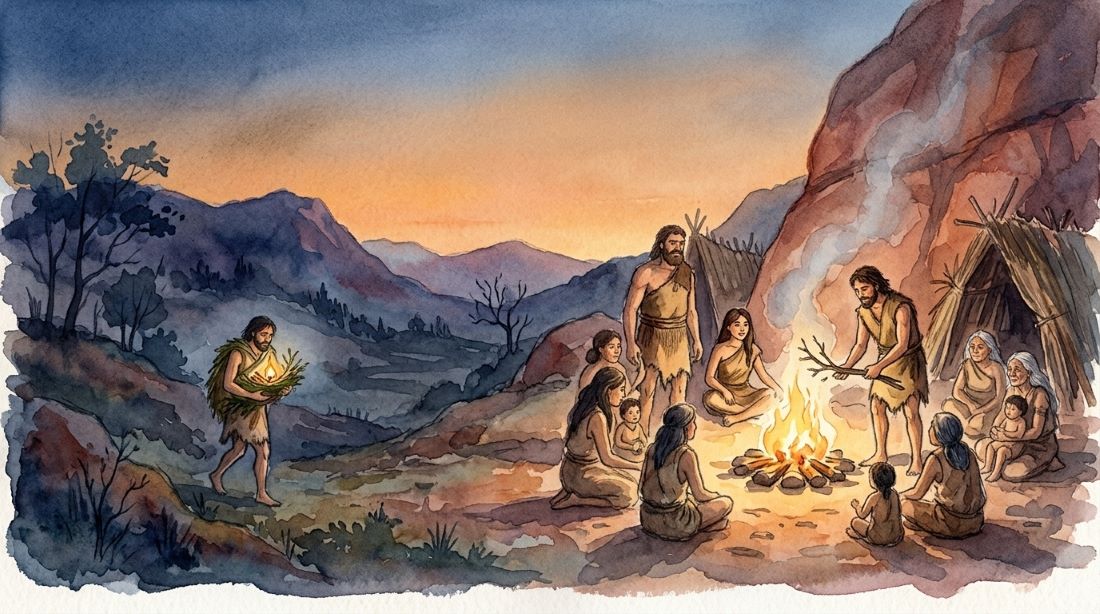
Long before cities, kings and written history, a small group of humans lived at the edge of a wide valley.
They called themselves, as far as we can imagine, the people of the Red Stone.
There were perhaps thirty of them: hunters, gatherers, mothers, children and old people who remembered things that nobody else did.
Among them was Aran, their leader.
And there was Mira, his daughter.
The people of the Red Stone had three fires.
One burned near their shelter and kept wild animals away. Another was used for cooking. The third was smaller and carefully protected. It was their travelling fire, kept alive from one day to the next.
Nobody knew exactly when their ancestors had first learned to control fire.
But they knew one thing very well:
Fire had to be protected.
The night everything changed
One evening, another group appeared.
They had been following the same animals and competing for the same water. There may have been shouting before the fighting began, but nobody in the Red Stone group remembered the words.
They remembered the fire.
As the two groups collided, the people fled toward the trees.
The first fire was trampled.
The second was scattered.
Aran’s brother tried to carry the third.
He managed to keep the glowing branch alive for some time, but during the escape they crossed a stream. The branch fell into the water.
When they finally stopped, the fire was gone.
All three fires were gone.
The people gathered in silence.
It was the first night they could remember without fire.
The children were cold. The adults were afraid. Somewhere beyond the darkness, animals were moving.
Aran looked at the group.
“We must bring it back,” he said.
Then he made a promise.
The man who returned with fire would marry Mira.
Three men volunteered.
One was Karo, the strongest hunter.
Another was Taren, young and quick.
The third was Naku, a quiet man who was not considered the strongest or bravest.
But Naku understood fire.
He had spent years watching the older members of the group keep the embers alive.
Naku’s journey
Before sunrise, the three men returned toward the abandoned camp.
They searched among the ashes.
Karo found nothing.
Taren found a blackened branch, but it was cold.
Naku kept searching.
Finally, beneath a layer of ash, he found something very small.
A glowing ember.
It was barely alive.
Naku carefully gathered dry grass and bark around it.
He breathed.
Nothing.
He breathed again.
A tiny red light appeared.
Then smoke.
Then, suddenly, a flame.
Naku stood there for a moment, staring at it.
He had not created fire.
He had saved it.
The three men began the journey home.
They carried the flame between them, shielding it from the wind.
When the people of the Red Stone saw smoke rising through the trees, they ran toward them.
For the first time since the attack, the darkness no longer seemed so frightening.
They built a new fire.
Everyone gathered around it.
Aran looked at Naku.
Then he looked at his daughter.
The promise had been made.
And that night, around a small fire in a world that had no cities, no writing and no recorded history, a group of humans once again had light, warmth and protection.
We do not know whether this particular story ever happened.
We do know that people were using and maintaining fire hundreds of thousands of years ago. Archaeological evidence shows ancient hearths used for cooking, warmth and other activities, while evidence from sites such as Barnham in England suggests that humans were deliberately making fire around 400,000 years ago.
The names Aran, Mira, Naku, Karo and Taren are inventions.
The fear of losing the fire is not.
Somewhere in the deep past, long before anyone could write down what happened, people must have faced that fear.
And perhaps someone really did walk into the darkness to bring the fire home.
Currently Reading
Historical Challenge: Can You Conquer the Past?
Answer more than 18 questions correctly, and you will win a copy of History Chronicles Magazine Vol 1! Take our interactive history quiz now and put your knowledge to the test!