
 By istorija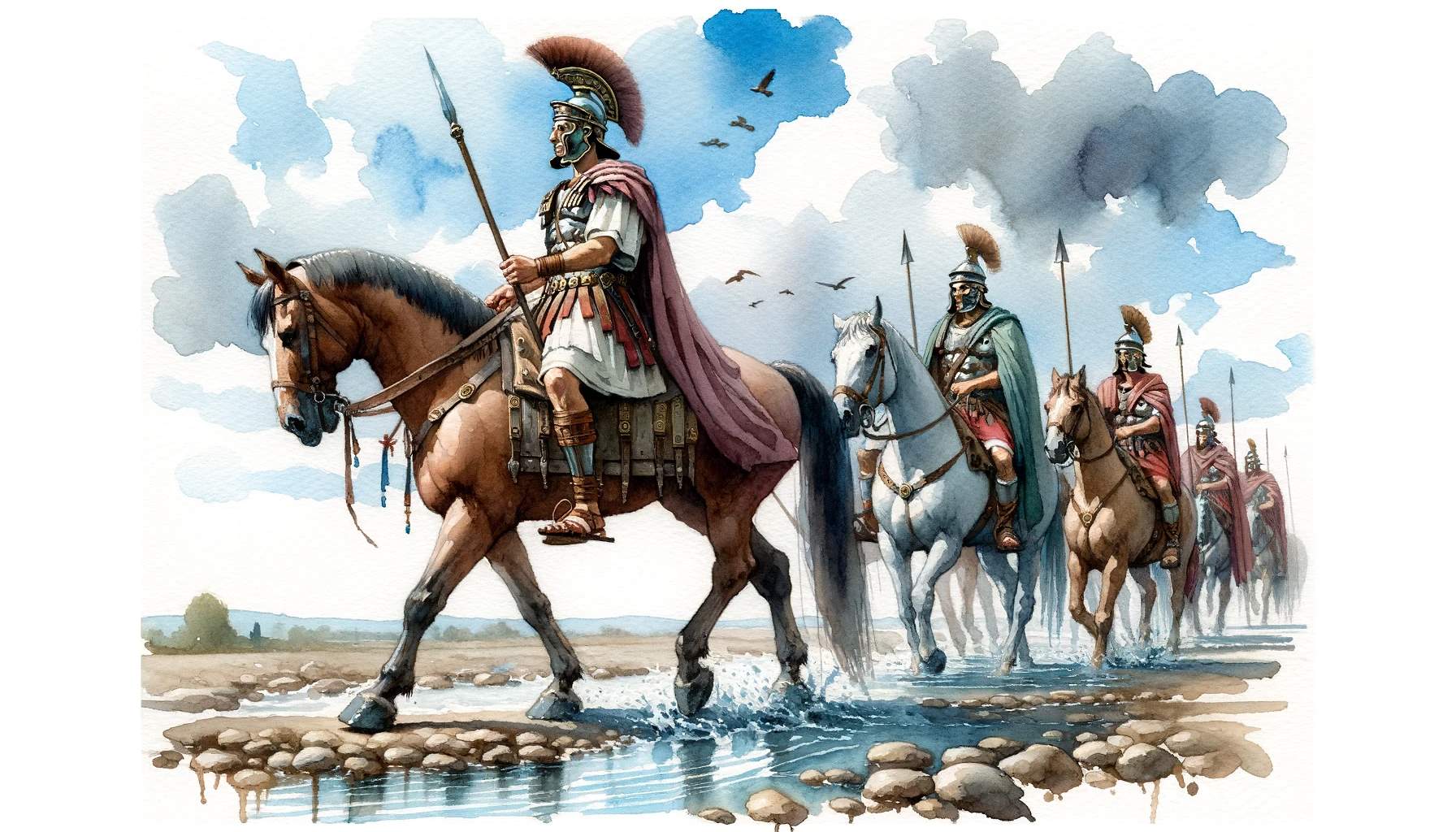
One of the most fate-laden events of Ancient Rome encapsulated in the phrase ‘Alea iacta est,’ was undoubtedly Julius Caesar’s decision to cross the Rubicon River with his Thirteenth Legion, an act that precipitated civil war within the Roman Republic.
This pivotal moment, steeped in defiance and fraught with peril, not only ignited a period of internal strife but also heralded the eventual downfall of the Republic and the genesis of the Roman Empire. Caesar’s bold move, accompanied by his proclamation ‘Alea iacta est,’ epitomized individual ambition overshadowing legal constraints, setting a precedent that would shape the contours of Roman and world history for centuries to come.
Alea Iacta Est
The phrase “Alea iacta est,” often translated as “The die is cast,” is attributed to Julius Caesar, marking his fateful decision to lead his army across the Rubicon River in 49 B.C.E. This statement is synonymous with a point of no return. Caesar’s utterance underscored the gravity of his insubordination, acknowledging the irreversible trajectory toward conflict that his actions endorsed. While the original phrasing as chronicled by Suetonius in “Vita Divi Iuli” is “Iacta alea est,” contemporary usage has seen a slight modification in the word order.
In modern discourse, this expression transcends its historical context, symbolizing a moment of decisive action when an individual commits to a chosen course, fully aware of the impactful consequences that will follow. It is invoked in various scenarios to denote a pivotal juncture, a moment when decisions have momentous effects, and retreat or second thoughts are no longer viable options.
The Rubicon, though geographically unimposing, was a river of enormous symbolic and legal significance in ancient Rome. It served as a frontier line that no general could lawfully cross with an army in tow without explicit authorization from the Roman Senate. This regulation safeguarded the Republic from internal military threat, ensuring that generals disbanded their legions and relinquished their imperium before crossing this boundary, thereby affirming their allegiance to Rome’s civilian governance.
However, in defiance of this long-standing tradition and legal standard, Caesar crossed the Rubicon with one legion, the Legio XIII Gemina. This act was not just a physical trespass but a stark declaration of rebellion against the Senate and his political adversaries. Caesar’s defiance set in motion a civil war, an event that precipitated the collapse of the Roman Republic and heralded the era of the Roman Empire.
Currently Reading


Historical Challenge: Can You Conquer the Past?
Answer more than 18 questions correctly, and you will win a copy of History Chronicles Magazine Vol 1! Take our interactive history quiz now and put your knowledge to the test!