
 By istorija

Around the year 1000, Viking explorers crossed the North Atlantic and reached the shores of North America, where they encountered Indigenous peoples whose ancestors had inhabited the continent for thousands of years. What followed was a remarkable series of encounters involving curiosity, trade, cultural misunderstandings, and violent clashes that would ultimately prevent the Norse from establishing a lasting settlement in the New World.
The Viking voyages to Vinland are often remembered as an extraordinary chapter in the history of exploration. Yet behind the stories of Leif Eriksson and the discovery of new lands lies another fascinating history: the first known encounters between Europeans and the Indigenous peoples of North America, long before Columbus crossed the Atlantic.
Two Worlds Across the Atlantic
By the end of the tenth century, Norse explorers had established settlements in Iceland and Greenland. Their expansion westward eventually brought them to the northeastern coast of North America, where they encountered territories rich in timber, fish, wildlife, and other natural resources.
The archaeological remains at L’Anse aux Meadows in Newfoundland provide definitive evidence of a Norse presence in North America around the beginning of the eleventh century. Research published in 2021 established that trees at the site had been cut in AD 1021, providing the first precise calendar date for Viking activity on the continent.
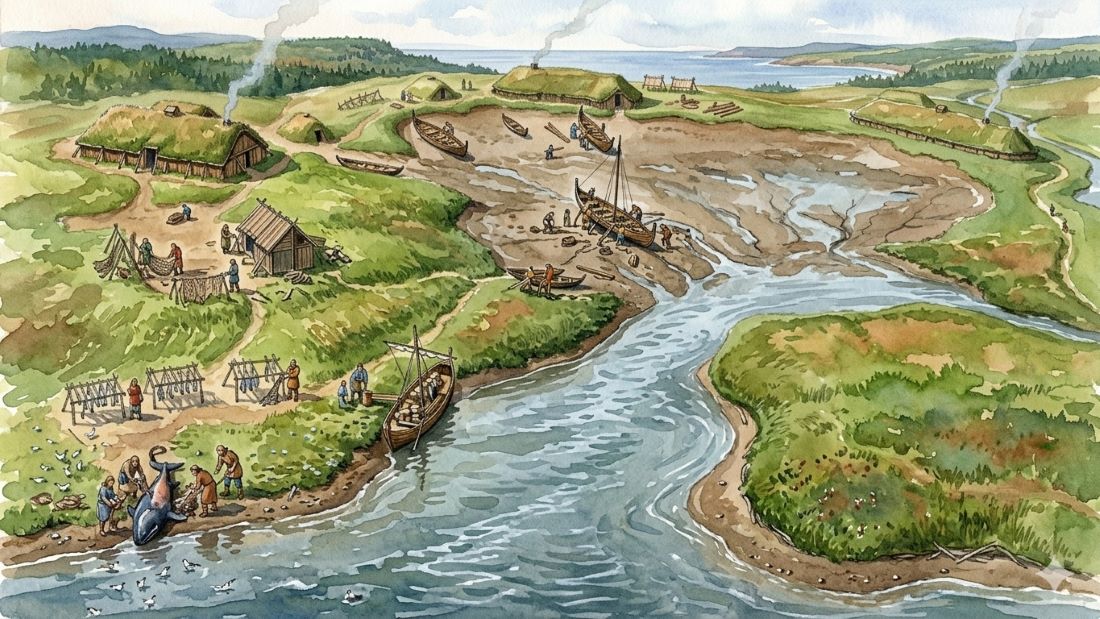
However, the Norse did not arrive in an uninhabited wilderness. Indigenous communities had occupied Newfoundland, Labrador, and the wider northeastern regions of North America for thousands of years. They possessed extensive knowledge of the landscape, local wildlife, fishing grounds, and seasonal patterns of movement.
These societies were not a single unified population. Depending on the region, the Norse may have encountered ancestors of peoples such as the Beothuk, Innu, Mi’kmaq, and other Indigenous communities. Further north, they also encountered or came into contact with Arctic peoples, including the Dorset and later Thule populations.
The distinction is important because the Viking accounts often describe their unfamiliar neighbours using one collective name, obscuring the diversity of the people they encountered.
Who Were the Skraelings?
In the Icelandic sagas, the Indigenous inhabitants of the lands west of Greenland are called Skraelings. The term appears in accounts of the Norse voyages to North America, as well as in descriptions of encounters with Indigenous populations in Greenland.
Its precise meaning and original connotations remain debated, but it was clearly a Norse designation for peoples whom the explorers considered unfamiliar.
The descriptions of the Skraelings are not entirely consistent. Some passages describe people travelling in small boats made from animal skins, while others mention their clothing, weapons, and trading practices. These descriptions probably reflect encounters with different communities rather than a single identifiable nation.
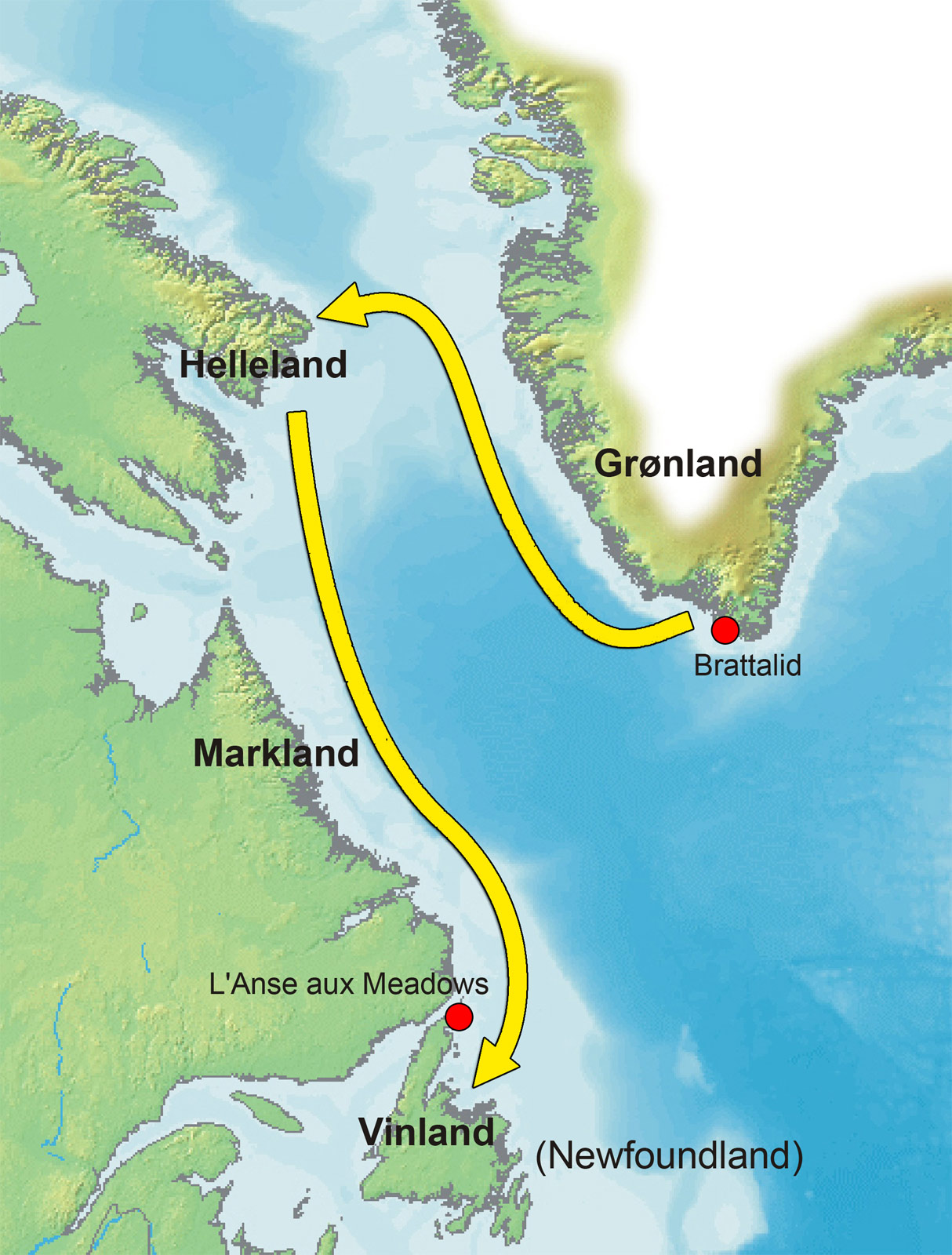
It is therefore misleading to assume that every Skraeling mentioned in the sagas was an Inuit person. The inhabitants of Newfoundland and the southern regions of the Norse exploration zone belonged to different cultural and historical traditions from the Arctic populations farther north.
The problem is further complicated by the nature of the surviving sources. The principal accounts, the Saga of the Greenlanders and the Saga of Erik the Red, were written down centuries after the voyages they describe. Although they preserve valuable traditions, their narratives must be treated with caution, particularly when attempting to reconstruct individual encounters.
The First Encounters: Curiosity and Fear
The Norse accounts suggest that the first encounters between the newcomers and Indigenous inhabitants were not necessarily hostile.
According to the Saga of Erik the Red, the expedition led by Thorfinn Karlsefni eventually encountered Indigenous people approaching their settlement in boats. Rather than immediately attacking, the newcomers initially appeared interested in establishing contact.
Karlsefni and his companions reportedly raised a white shield as a sign of peaceful intentions. The two groups then began exchanging goods.
The Norse offered red cloth, while the Indigenous visitors showed particular interest in the material. In return, they provided furs and animal skins, valuable commodities in the North Atlantic trading world.
The exchanges were apparently successful enough to encourage further contact. More Indigenous visitors arrived, and the Norse continued trading with them.
However, Karlsefni was cautious about what his people were willing to exchange. The Indigenous traders reportedly expressed interest in obtaining swords and spears, but the Norse leader prohibited the sale of weapons.
This decision reveals an important aspect of the relationship. Both sides recognised the potential value of exchanging goods, but neither could be certain of the intentions or military capabilities of the other.
For the Norse, metal weapons represented an important technological and military advantage. Giving them away could potentially strengthen a neighbouring population that might later become hostile.
Nevertheless, the trading episodes suggest that peaceful interaction was possible and that the first meetings were not simply a succession of battles.
When Trade Turned to Violence
The relationship between the Norse and Indigenous inhabitants eventually deteriorated.
One of the earliest violent episodes appears in the Saga of the Greenlanders, which describes an expedition led by Thorvald Eriksson, the brother of Leif Eriksson.
Thorvald and his companions were exploring the coast when they discovered several Indigenous people in small boats. The Norse attacked, killing eight of the nine occupants, while one managed to escape.
The following day, the expedition encountered a much larger force of Indigenous warriors approaching in boats. According to the saga, they surrounded the Norse ships and launched an attack.
During the fighting, Thorvald was struck by an arrow and mortally wounded.
His death is one of the most significant episodes in the surviving accounts of Viking–Indigenous relations. It demonstrates that the Norse, despite their military experience and reputation as formidable warriors, were vulnerable when operating far from their established settlements.
The story also raises an important question: was this attack an act of retaliation for the earlier killing, or had tensions already developed between the two groups? The saga does not provide enough information to establish the exact circumstances.
Whatever the immediate cause, the encounter demonstrated that the Norse could not simply impose their will on the inhabitants of the region.
Thorfinn Karlsefni and the Attempt to Establish a Settlement
Perhaps the most detailed account of contact between the two populations comes from the expedition led by Thorfinn Karlsefni, a wealthy Icelandic merchant who attempted to establish a permanent settlement in Vinland around the beginning of the eleventh century.
According to the sagas, Karlsefni assembled a considerable expedition consisting of several ships and approximately 160 people, including women and livestock. Unlike earlier exploratory voyages, this expedition had a more ambitious objective: to establish a settlement and exploit the resources of the newly discovered territory.
The initial conditions appeared promising. The Norse found fertile land, abundant fish, wild animals, and vegetation that offered opportunities for agriculture and livestock raising.
They established themselves in the region and spent a winter there.
Contact with Indigenous inhabitants initially developed through trade, but relations gradually became more difficult. One episode described in the sagas involved a bull belonging to the Norse settlement.
When the animal suddenly appeared and frightened the Indigenous visitors, they reportedly interpreted the incident as a threat and withdrew.
Not long afterwards, a larger group returned, and the situation escalated into a confrontation.
The Norse attempted to defend themselves, while the Indigenous warriors attacked with projectiles and other weapons. One particularly memorable passage describes the use of large stones launched against the Norse positions.
The saga also recounts the actions of Freydis Eiriksdottir, who allegedly encouraged the retreating Norsemen to stand their ground. When the situation became desperate, she reportedly took up a sword and struck her chest with it, frightening the attackers.
Although the episode is dramatic, it is important to remember that the saga was written long after the events and that its portrayal of Freydis may contain literary embellishment.
Despite the temporary success of the Norse defenders, the situation remained unstable. Karlsefni eventually decided to abandon the settlement and return to Greenland.
The attempt to establish a permanent European presence in Vinland had failed.
Did Vikings and Indigenous Peoples Trade Beyond Vinland?
The relationship between the Norse and Indigenous populations may have extended considerably beyond the settlement at L’Anse aux Meadows.
Archaeological discoveries in the eastern Canadian Arctic provide evidence of contact between Norse Greenlanders and Inuit communities.
At sites such as Skraeling Island in Nunavut, archaeologists have recovered objects of Norse origin, including fragments of chain mail, iron tools, boat rivets, and pieces of woollen fabric.
These discoveries are particularly interesting because they suggest that Norse manufactured goods circulated among Indigenous communities far from the main Viking settlement in Newfoundland.
Some objects may have been obtained through direct trade, while others could have been salvaged from abandoned Norse vessels or settlements. Archaeologists cannot establish the precise circumstances behind every discovery.
Another intriguing find comes from the Okivilialuk archaeological site on Baffin Island. A small wooden human figurine appears to depict a European traveller wearing clothing different from traditional Inuit garments. A cross carved on the figure’s chest has led researchers to suggest that it may represent a Christian Norseman.
If this interpretation is correct, it offers a rare glimpse of how Indigenous artists may have represented the foreign visitors they encountered.
Taken together, these discoveries suggest that the relationship between the Norse and Indigenous peoples was not confined to the dramatic encounters described in the Icelandic sagas. Trade, the movement of objects, and occasional contact may have continued across the North Atlantic Arctic for generations.
Why Did the Vikings Fail to Establish a Permanent Presence?
The failure of the Norse to establish a lasting settlement in North America cannot be explained by a single battle or a simple military defeat.
Geography was an enormous obstacle. The Norse settlements in Greenland were already isolated from the rest of the European world, and the journey to Newfoundland required crossing vast stretches of the North Atlantic.
Maintaining a permanent colony would have demanded regular supplies, additional settlers, and reliable communication with Greenland. These requirements were difficult to fulfil even under favourable conditions.
The presence of established Indigenous populations created another challenge. The Norse were entering territories that already belonged to communities with extensive knowledge of the environment and established patterns of social and economic life.
The newcomers could not assume that their weapons, ships, or experience of warfare would guarantee success.
The Icelandic sagas repeatedly portray the Indigenous inhabitants as a source of danger to the Norse settlements. Modern historians, however, must consider the possibility that the encounters were shaped by competing interests, misunderstandings, retaliation, and the limited ability of either side to maintain peaceful relations over long distances.
The Norse settlements in North America were therefore vulnerable not simply because of local resistance, but because they lacked the demographic and logistical resources required to sustain a distant colonial presence.
The exact circumstances surrounding the abandonment of Vinland remain uncertain, and it would be misleading to attribute the entire failure to Indigenous resistance alone.
A Forgotten Chapter of Atlantic History
The encounters between Vikings and Indigenous peoples of North America represent one of the most remarkable episodes in medieval history.
Long before Columbus, Europeans and the inhabitants of the American continent had already met, traded, fought, and attempted to coexist. The surviving accounts reveal a relationship that was neither exclusively peaceful nor defined entirely by warfare.
For the Norse, Vinland represented an opportunity to expand their settlements, acquire valuable resources, and explore lands beyond the familiar boundaries of the North Atlantic world. For the Indigenous inhabitants, the arrival of unfamiliar seafarers introduced new possibilities for trade, but also potential threats to their communities and territories.
The Norse eventually withdrew, leaving behind archaeological traces of their presence and a collection of stories that would survive for centuries.
Unlike the later European colonisation of the Americas, these early encounters did not lead to a permanent transformation of the continent’s Indigenous societies. There is no convincing evidence that the Norse presence produced major lasting changes among the populations they encountered.
Yet their voyages remain historically significant. They demonstrate that the Atlantic was crossed in both directions long before the age of Columbus, and that the history of contact between Europe and North America began not with the Spanish conquest, but with a much earlier and largely forgotten encounter between Norse sailors and the Indigenous peoples of the New World.
Currently Reading
Historical Challenge: Can You Conquer the Past?
Answer more than 18 questions correctly, and you will win a copy of History Chronicles Magazine Vol 1! Take our interactive history quiz now and put your knowledge to the test!