
 By istorija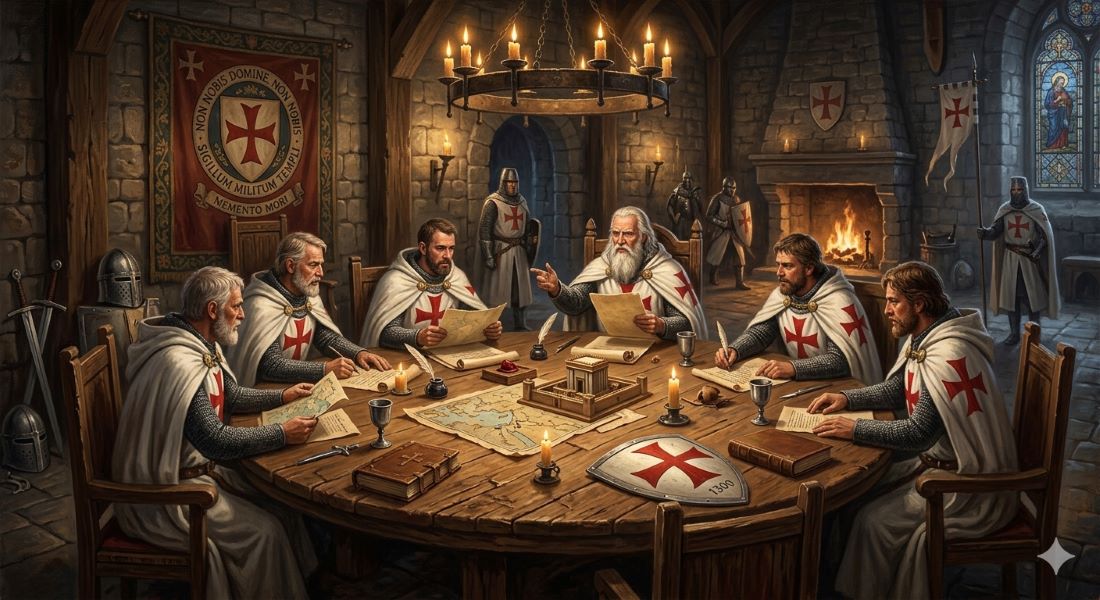
The Knights Templar (Poor Fellow-Soldiers of Christ and of the Temple of Solomon) rose from humble protectors of pilgrims in 1119 to become one of medieval Europe’s most powerful military and financial institutions. By the late 13th century, after the fall of Acre in 1291 and the end of the Crusader states, their military role diminished, but their wealth and banking network made them targets. Their dramatic downfall in 1307–1314, orchestrated largely by King Philip IV of France, combined political opportunism, financial desperation, and fabricated charges of heresy. Myths of hidden treasure, esoteric secrets, and survival as a shadowy force have persisted ever since, blending fact with speculation.
The Financial and Political Context Leading to Collapse
After the loss of the Holy Land, the Templars relocated their headquarters to Paris, where they operated Europe’s most sophisticated banking system. They loaned money to kings, nobles, and merchants, held vast estates across Europe, and managed pilgrim deposits and transfers. This wealth made them rivals to monarchs.
King Philip IV (“the Fair”) of France was deeply in debt to the Order after wars with England and Flanders. He had already expelled Jews in 1306 to seize their assets and debased the currency. The Templars, exempt from royal taxes and answerable only to the Pope, represented an independent power base. Philip saw an opportunity: destroy the Order, confiscate its French properties, and erase his debts.
The Arrests of Friday, 13 October 1307
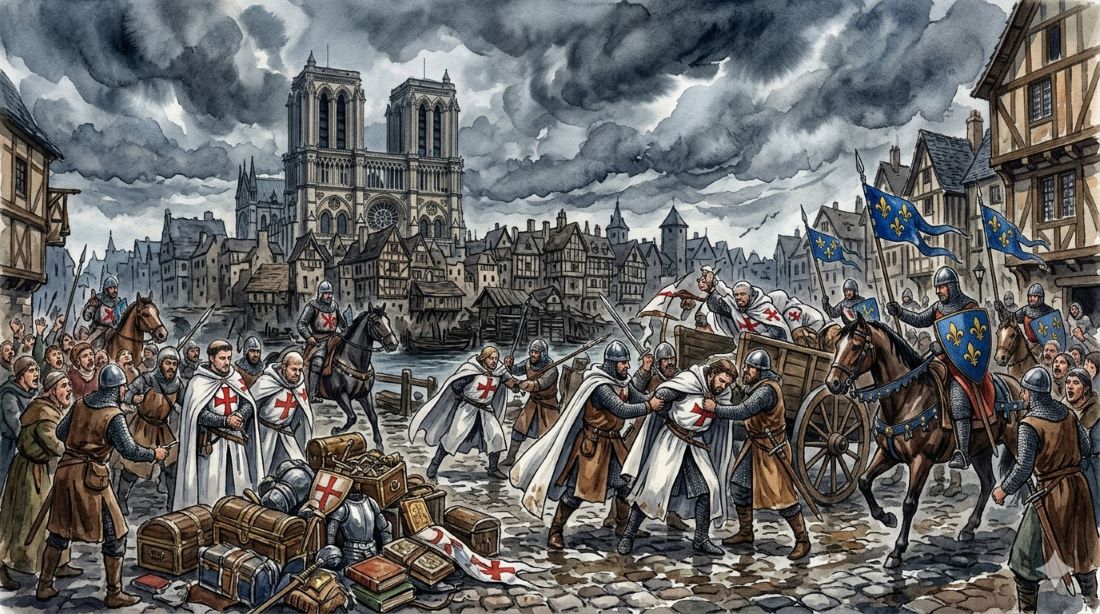
On 14 September 1307, Philip issued sealed orders to arrest all Templars in France. On the morning of Friday, 13 October, royal agents seized hundreds—including Grand Master Jacques de Molay—in coordinated raids. Properties were confiscated, and prisoners were handed to royal officials (and soon the Inquisition) for interrogation.
Philip’s propaganda machine spread lurid accusations: heresy, blasphemy, idolatry, sodomy, and financial corruption. The charges included:
- Denying Christ and spitting/trampling on the Cross during initiation.
- Obscene “kisses” on the lower spine, navel, and mouth.
- Worshipping an idol (a bearded head called Baphomet).
- Homosexual acts and sodomy.
- Usury and secret pacts with Muslims.
These claims originated partly from disgruntled ex-members (e.g., Esquiu de Floyran, who informed Philip in 1305) but were amplified under torture.
The Trials: Torture, Confessions, and Papal Involvement
Pope Clement V (a French puppet elected under Philip’s influence) initially protested the arrests as an infringement on papal authority but issued the bull Pastoralis praeeminentiae (22 November 1307) ordering monarchs across Christendom to arrest Templars.
Interrogations relied heavily on torture: the rack, strappado, burning feet, starvation. Many Templars confessed under duress, then recanted when torture stopped. When 54 recanters were burned as relapsed heretics in 1310, others feared the same fate.
The papal commission in Paris (1310–1311) heard hundreds of testimonies. While some charges (e.g., spitting on the Cross) appeared in coerced confessions, evidence for systematic heresy or idolatry was weak. No physical idols were found, and many Templars denied sodomy or secret rites.
At the Council of Vienne (1311–1312), Clement dissolved the Order via Vox in excelso (1312), citing scandal and the impossibility of reform—not proven guilt. Properties were transferred to the Hospitallers (though Philip seized much in France).
Jacques de Molay and other leaders were burned at the stake in Paris on 18 March 1314. De Molay reportedly recanted his confession and cursed Philip and Clement, both of whom died soon after—fueling later legends.
Myths of the Lost Treasure
The Templars’ wealth was vast (lands, preceptories, cash), but mostly illiquid—tied to estates and loans. After arrests, French royal inventories seized what was in Paris and commanderies, but rumors spread that a secret fleet escaped from La Rochelle with treasure.
Popular legends claim:
- The treasure included the Holy Grail, Ark of the Covenant, or secret documents (e.g., proof of Jesus’ bloodline from Holy Blood, Holy Grail theories).
- It was hidden in Rennes-le-Château (linked to priest Bérenger Saunière’s sudden wealth in the 1890s) or Rosslyn Chapel (Scotland).
- It reached Oak Island (Nova Scotia), inspiring the “Money Pit” and The Curse of Oak Island TV series.
Historical evidence debunks large-scale escape: no records show a major fleet fleeing; most Templars in France were arrested; surviving assets went to the Hospitallers or crown. The “treasure” myth grew from medieval propaganda, 19th-century occultism (e.g., Freemasonry links), and 20th-century books like The Holy Blood and the Holy Grail (1982).
Secrets and Esoteric Legends
Accusations of secret rites (Baphomet, Gnostic beliefs) were likely fabrications or misinterpretations of initiation ceremonies (e.g., symbolic denial of Christ to prepare for capture/torture by Muslims). No credible evidence supports occult practices.
Modern myths tie Templars to:
- Freemasons (as supposed guardians of esoteric knowledge).
- The Holy Grail or Jesus/Mary Magdalene bloodline.
- Pre-Columbian voyages to America.
These lack primary sources and stem from pseudohistory. The real “secret” was their banking innovation and independence, which made them politically dangerous.
Conclusion: Greed, Power, and Enduring Myth
The Templars’ downfall was driven by Philip IV’s financial desperation and desire to eliminate a rival power, not genuine heresy. Torture produced false confessions; the Pope bowed to pressure. Their “treasure” was seized or dissipated, not hidden in exotic locations.
The legends endure because the sudden fall of such a powerful order invites conspiracy thinking. The Templars remain a symbol of lost glory, hidden knowledge, and the clash between church, state, and wealth.
Currently Reading

Historical Challenge: Can You Conquer the Past?
Answer more than 18 questions correctly, and you will win a copy of History Chronicles Magazine Vol 1! Take our interactive history quiz now and put your knowledge to the test!