
 By istorija
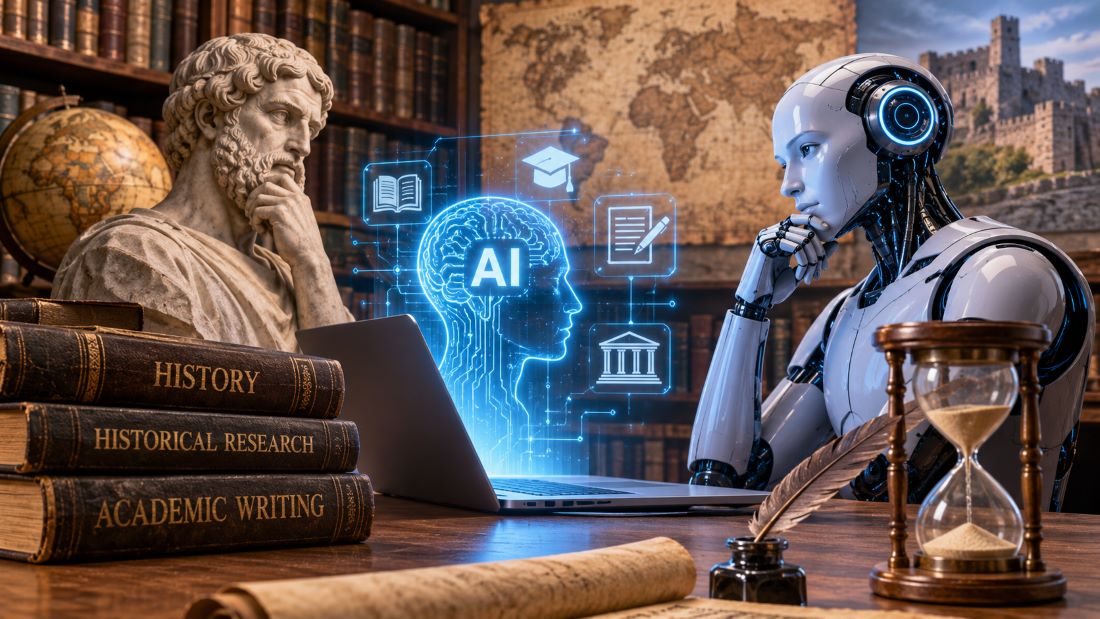
Artificial intelligence has become an increasingly present part of our everyday lives, and there is little reason to believe that this trend will slow down. On the contrary, AI will almost certainly become even more integrated into the way we work, communicate, learn, and understand the world around us. Historical research is no exception. What was until recently considered a relatively distant technological development is now entering the field of history, changing not only how historical information is accessed and processed, but also how historical knowledge is produced.
Even this blog, HistoryChronicles, which you are reading now, is extensively written and supported with the help of artificial intelligence. I see no particular problem with that. This is a popular history blog, intended for a broad audience rather than an academic publication. Its purpose is to make historical subjects accessible, interesting, and understandable to readers. AI can be an extremely useful tool in achieving that goal, provided that the information is checked, sources are taken seriously, and historical accuracy remains the priority. The situation, however, becomes considerably more complicated when we move from popular history into the academic world.
Artificial intelligence is increasingly finding its way into universities, and not only among undergraduate students. Master’s and doctoral students are also using these tools, sometimes to an extent that raises fundamental questions about academic work, originality, and the very process of historical research. Where does assistance end and authorship begin? If a student uses AI to structure an argument, analyse sources, improve academic language, or even draft substantial portions of a thesis, how should that work be evaluated? These are no longer theoretical questions. Universities and academic institutions are already facing them, often without having clear answers.
I find myself in an interesting, and sometimes uncomfortable, position when considering this issue. Before 2022, I had written three monographs, works that remain a source of considerable personal pride. Writing a historical monograph is a demanding process, requiring months, sometimes years, of research, reading, writing, revising, and reconsidering arguments. Yet today, whenever I begin working on an academic paper or contemplate a new monograph, I face the temptation of using AI to a much greater extent than I perhaps should. It is difficult to ignore such a powerful tool when it is literally at your fingertips. It can help organise ideas, identify connections, improve the structure of an argument, and make the writing process considerably faster. The challenge is knowing where to draw the line.
Recently, I was discussing this subject with a colleague who is a university professor. He told me that a faculty meeting had effectively reached the conclusion that the battle against AI-generated academic work had already been lost. Professors can no longer reliably establish whether a particular piece of writing was produced by a student, written with substantial AI assistance, or generated almost entirely by artificial intelligence. AI detection software is far from reliable, and attempting to police every sentence has become an increasingly futile exercise. According to him, the emphasis is now shifting towards a different question: can the student actually defend the work? Can they explain its arguments, justify their conclusions, discuss the sources, and demonstrate a genuine understanding of the subject? Whether they wrote every sentence themselves or relied heavily on AI assistance is becoming, in this approach, a secondary consideration.
There is certainly something unsettling about this shift, but it may also reflect the reality we have to accept. Artificial intelligence is not going away, and historians are no more immune to its influence than anyone else. We can either pretend that these tools do not exist, or learn how to use them responsibly. I believe the latter is the only realistic approach. However, there is one condition that must never be compromised: historical accuracy. AI can assist with research and writing, but it cannot replace the historian’s responsibility to question information, examine primary sources, verify references, recognise historical context, and distinguish between established facts and plausible-sounding inventions.
Ultimately, the greatest danger is not that artificial intelligence will help us write history, but that we might gradually stop doing the intellectual work that makes historical writing meaningful in the first place. A well-written academic paper is not necessarily a good piece of historical research. Behind every serious historical argument there must be evidence, critical thinking, and an author who understands and stands behind every conclusion. AI may change the tools we use, perhaps even the entire process of producing historical scholarship, but it should never become a substitute for historical judgement.
The future of historical writing will almost certainly involve artificial intelligence. The real question is not whether historians will use it, but whether they will remain historians while doing so.
Currently Reading

Historical Challenge: Can You Conquer the Past?
Answer more than 18 questions correctly, and you will win a copy of History Chronicles Magazine Vol 1! Take our interactive history quiz now and put your knowledge to the test!