
 By istorija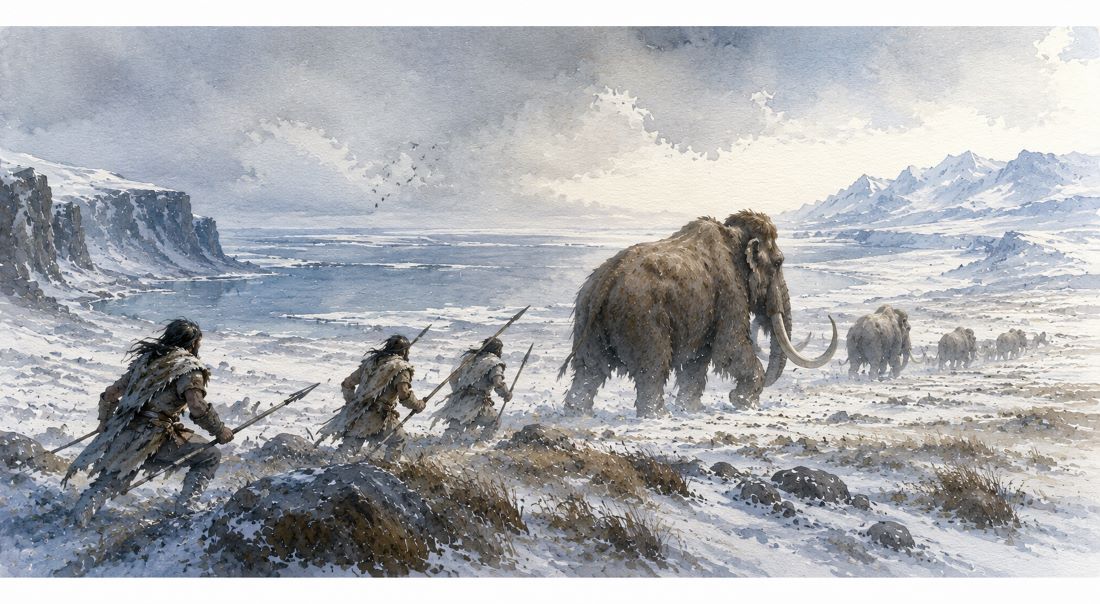
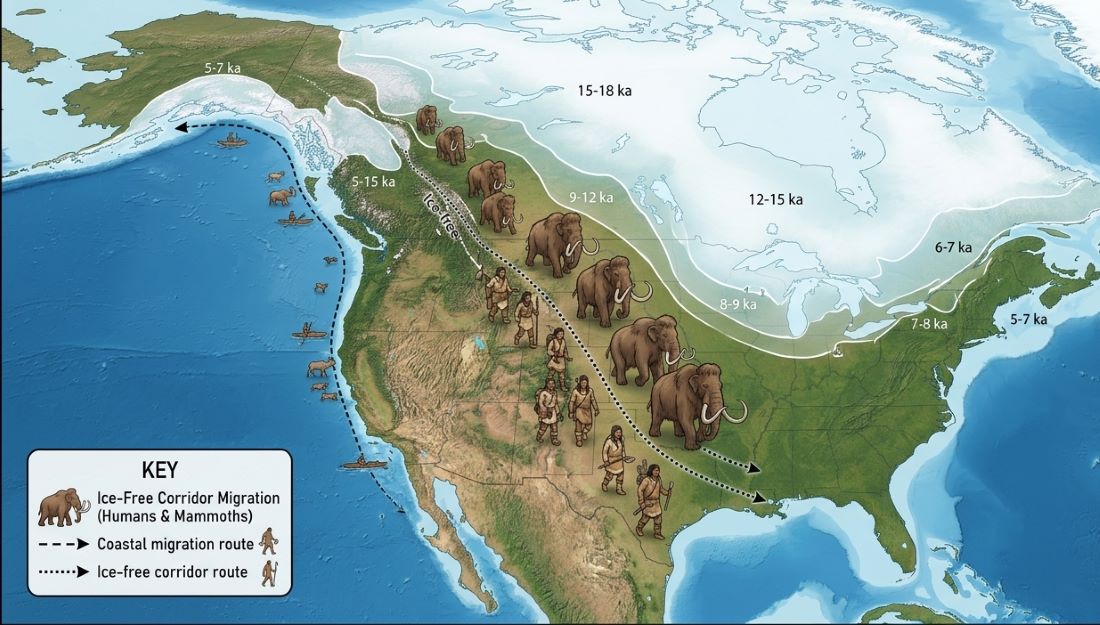
For generations, the story of how humanity first set foot in the Americas was treated as a settled chapter in textbook history. Schoolchildren were taught a linear narrative: at the end of the last Ice Age, bands of Siberian big-game hunters crossed Beringia—a temporary land bridge connecting Russia to Alaska. They migrated south through a narrow, ice-free corridor in western Canada and populated two continents, leaving behind their distinct, finely crafted stone spearheads. These people were dubbed the Clovis culture, and for decades, they stood as the primary framework for understanding the populating of the New World.
Today, that traditional Clovis-First paradigm has been significantly revised.
Rather than a single, uniform migration event, modern archaeology, anthropology, and genetics view the populating of the Americas as a highly complex, multi-layered process. Recent discoveries have shown that the traditional model is no longer considered sufficient on its own, replacing it with a nuanced scientific frontier where experts continuously evaluate new timelines, alternative routes, and conflicting lines of evidence.
Expanding the Timeline: The Pre-Clovis Evidence
The traditional “Bering Strait Land Bridge” theory relied on the premise that humans could not have entered the Americas before roughly 13,000 to 13,500 years ago, as massive, miles-thick glacial sheets blocked all southward passage.
However, over the last few decades, a growing body of “Pre-Clovis” evidence has led researchers to look toward earlier entry dates:
-
Monte Verde (Chile): Located near the southern tip of South America, this pristine bog site fundamentally altered the academic landscape by revealing evidence of human butchery, wooden architectural stakes, and medicinal seaweed dating to at least 14,500 years ago. Because this site is located so far south, it strongly implies that human populations had bypassed the northern ice sheets long before the inland corridor became viable.
-
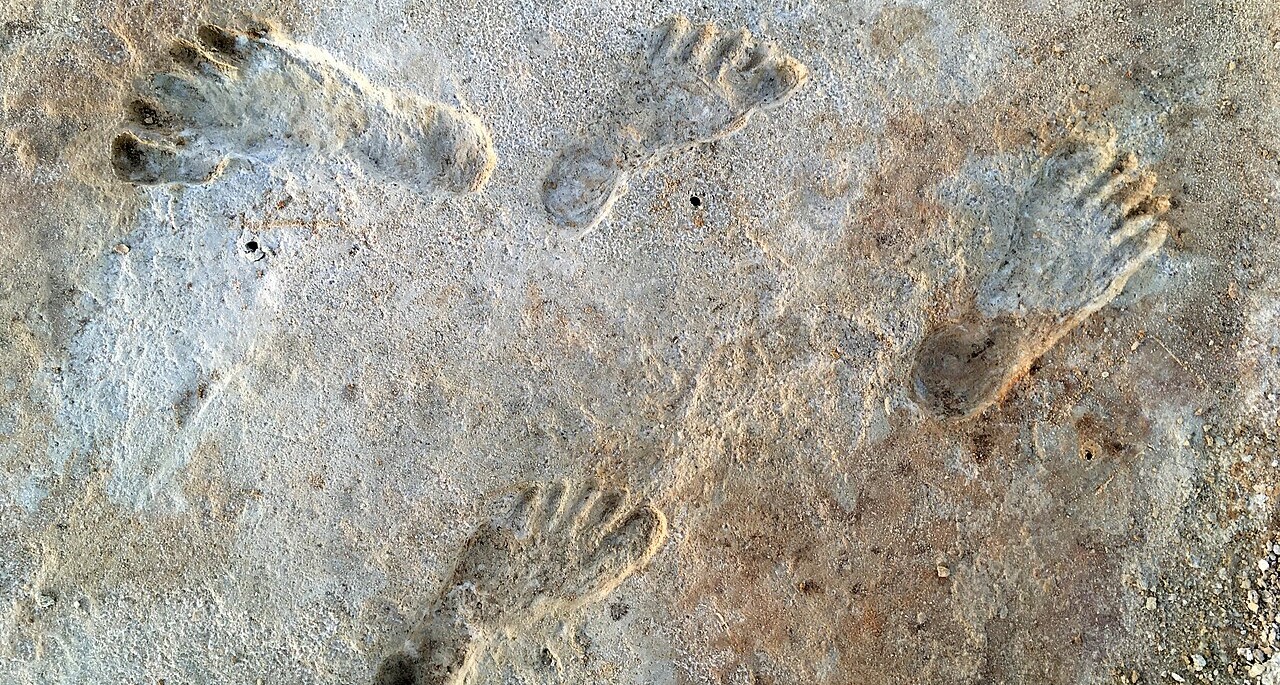
White Sands Footprints (New Mexico): In 2021, researchers announced the discovery of fossilized human footprints embedded in an ancient lake bed in New Mexico, initially dated between 21,000 and 23,000 years ago. While these dates are still actively debated and scrutinized regarding the reliability of the dated organic material, they represent a highly compelling challenge to the traditional chronology.
The Kelp Highway: Modeling the Glacial Coasts
If the inland ice-free corridor was closed or impassable when the earliest migrations began, alternative pathways must be explored. The leading mainstream model among contemporary archaeologists is the Coastal Migration Theory, often referred to as the Kelp Highway.
This model suggests that instead of trekking through a frozen interior, early maritime-adapted peoples may have used watercraft to hug the North Pacific coastline. Moving along the rim of modern-day Russia, Alaska, and British Columbia, they are thought to have skirted past the edges of the massive continental glaciers.
Theoretically, this coastal environment would have been highly favorable. The coastlines were anchored by massive underwater kelp forests, which supported a rich, stable ecosystem of fish, sea mammals, shellfish, and seabirds. This “highway” is hypothesized to have allowed populations to migrate down the Pacific coast without needing to adapt to drastically changing terrestrial biomes.
The primary challenge facing researchers attempting to verify this model is sea-level rise. As the Ice Age ended, melting glaciers caused global oceans to rise by hundreds of feet, submerging potential ancient coastal campsites deep under the Pacific Ocean and leaving the theory largely reliant on indirect evidence.
Transpacific Hypotheses: Polynesians and the Sweet Potato Question
While mainstream science focuses heavily on the Pacific Rim, more speculative hypotheses have occasionally raised the question of whether early humans crossed the open expanse of the Pacific Ocean from Oceania.
The idea of pre-Columbian contact between Polynesians—the renowned navigators of the South Pacific—and South American populations remains a polarizing and highly contested topic in anthropology.
The Genetic Debate
In recent years, certain genetic studies identified subtle genetic signatures in specific indigenous South American groups, such as the Botocudo of Brazil, that showed unexpected affinities to Australasian populations. However, the scientific community treats this data with extreme caution. Most mainstream geneticists emphasize that there is currently no consensus-backed evidence of a widespread, pre-Columbian Polynesian genetic contribution to the American continents, and many look to ancient, shared Siberian ancestry to explain these anomalies.
The Botanical Puzzle
The most intriguing argument for transpacific contact lies in botany and linguistics, specifically regarding the sweet potato (Ipomoea batatas). Native to the Andes mountains, the sweet potato was an established staple crop across Polynesia prior to European exploration.
Furthermore, linguists have noted that the word for sweet potato in several Polynesian languages is kumara, which closely resembles kuumala—the term used by the indigenous Quechua people of the Peruvian Andes. While this connection suggests the possibility of some form of limited, pre-Columbian maritime contact or trade, scholars remain deeply divided on whether it represents a deliberate transpacific voyage, accidental drifting, or independent linguistic convergence.
Experimental Archaeology: Thor Heyerdahl’s Transatlantic Voyages
When evaluating alternative maritime routes, researchers must also address the question of ancient seafaring capabilities. To explore what was technologically possible, 20th-century iconoclasts turned to experimental archaeology.
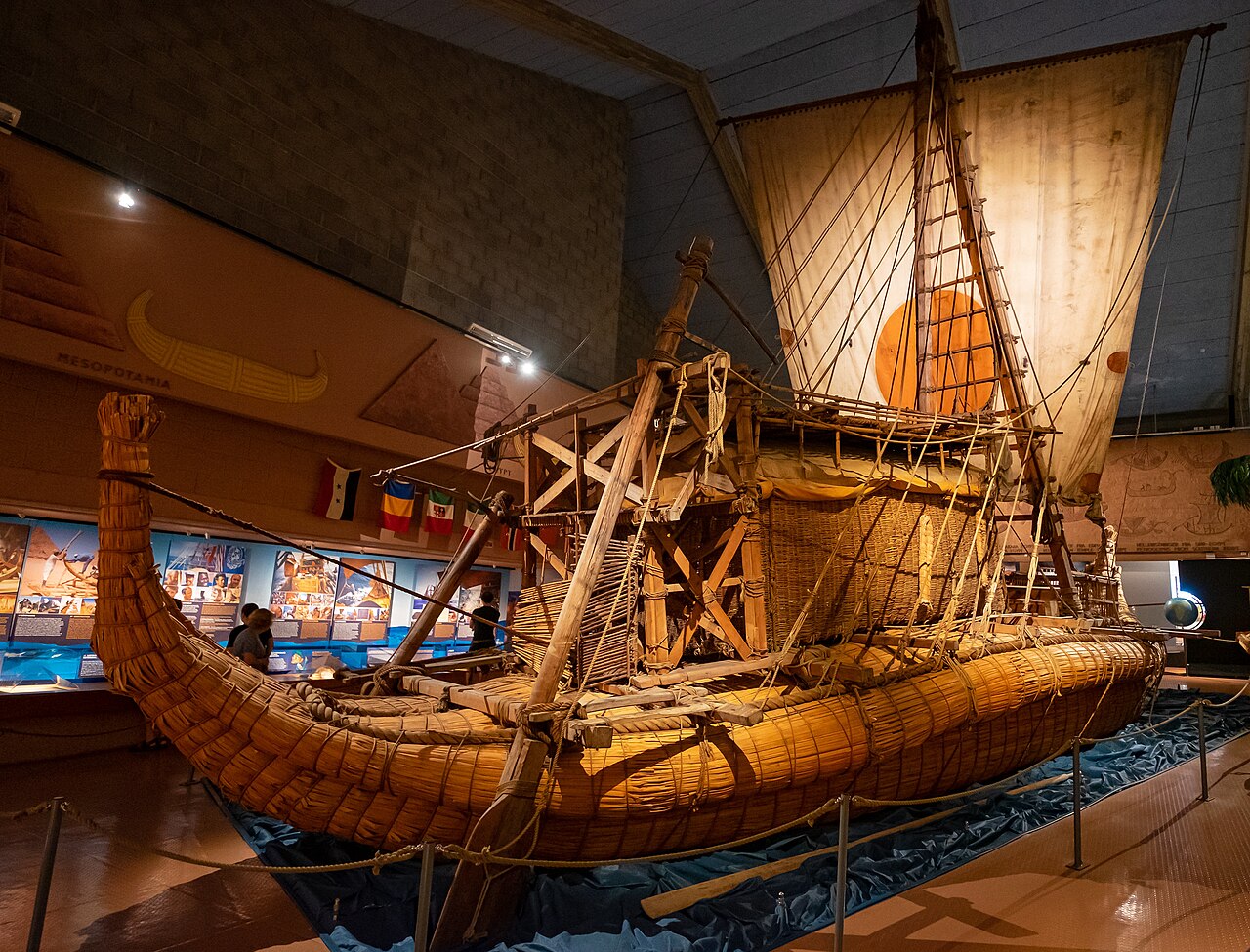
The most famous figure in this field was the Norwegian adventurer and ethnographer Thor Heyerdahl. Observing cultural parallels between early Mediterranean civilizations and the pre-Columbian Americas—such as reed boat construction and step-pyramids—Heyerdahl hypothesized that ancient transatlantic contacts could have occurred long before the arrival of Columbus or the Norse.
To demonstrate the feasibility of ancient hull designs, Heyerdahl launched two notable experiments:
-
The Ra I (1969): Built from papyrus reeds based on ancient Egyptian illustrations, the vessel took on water and suffered structural failure just short of its Caribbean destination due to construction flaws.
-
The Ra II (1970): Utilizing traditional reed-weaving techniques from Lake Titicaca in Bolivia, Heyerdahl constructed a second papyrus vessel. Sailing from Morocco, the Ra II successfully crossed 3,200 miles of open ocean to land safely in Barbados.
Heyerdahl’s voyages provided definitive proof that ancient reed vessels possessed the buoyancy and integrity to cross the Atlantic via natural trade winds and currents. However, mainstream archaeology remains highly skeptical of an active Egyptian-American connection, emphasizing that proving a voyage is technically possible is not the same as proving it historically happened. To date, no verified, physical Old World artifacts from that era have been recovered in pre-Columbian contexts.
Conclusion: A Weighted Spectrum of Evidence
The quest to identify the first inhabitants of the Americas has evolved from a rigid, single-route timeline into a multi-directional investigation. However, within modern academia, these various hypotheses are not ranked equally:
-
The Scientific Consensus: Multiple waves of migration originating from Northeast Asia, with the pre-Clovis timeline (at least 14,500 years ago) now firmly established.
-
The Leading Model: The Coastal Migration Theory (Kelp Highway), which is widely accepted as the most logically viable route bypassing the glaciers, despite its primary sites being submerged.
-
The Speculative Fringe: Transpacific and transatlantic contacts (Polynesians or Egyptians), which remain intriguing anomalies or proofs of technological capability, but lack the robust physical and genetic evidence required to accept them as major historical drivers.
As genetic sequencing techniques become more precise and underwater archaeology begins to explore the drowned coastlines of the Americas, the narrative will continue to adapt—proving that the deep history of the Americas is far older, more diverse, and beautifully complicated than previously thought.
Currently Reading

Historical Challenge: Can You Conquer the Past?
Answer more than 18 questions correctly, and you will win a copy of History Chronicles Magazine Vol 1! Take our interactive history quiz now and put your knowledge to the test!