Tenochtitlan – The Magnificent Aztec Capital That Astonished the Spanish Conquistadors
Every now and then, a book introduces me to a historical subject that deserves a closer look. This time, it was Brian Lavery’s The Conquest of the Ocean, a fascinating account of exploration, maritime expansion, and the encounters that reshaped the world. Among its many historical episodes, one passage particularly caught my attention: the arrival of Hernán Cortés and his men at the Aztec capital of Tenochtitlan. Their descriptions of the city, its enormous marketplaces, magnificent houses, waterways, and monumental temples offer a remarkable glimpse into a world that was entirely unfamiliar to the European newcomers. It seemed like a perfect subject for another article on History Chronicles.
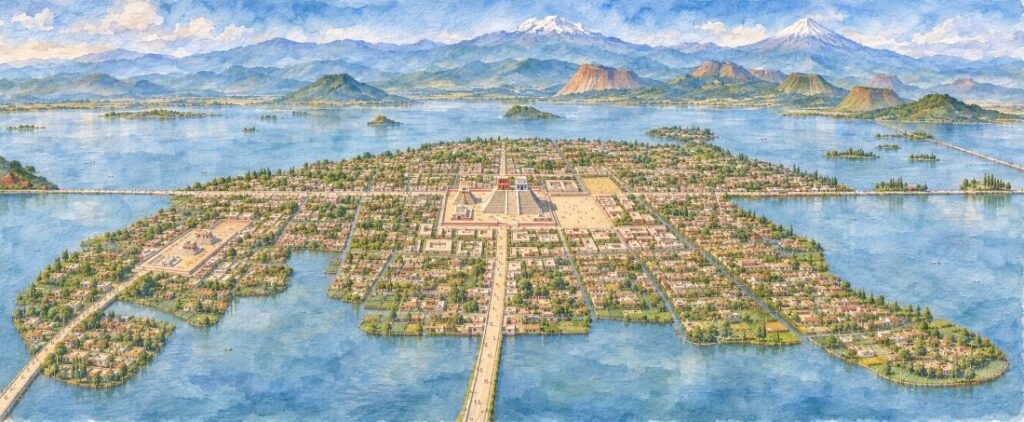
When the Spanish conquistadors approached the great city in November 1519, they encountered something that challenged their understanding of the world beyond Europe. Rising from the waters of Lake Texcoco, surrounded by mountains and connected to the mainland by enormous causeways, Tenochtitlan was a metropolis of extraordinary proportions. Its architecture, urban organisation, and bustling commercial life astonished even men who had come from some of Europe’s great cities. The surviving accounts of those first encounters reveal just how remarkable the Aztec capital appeared to its European visitors.
The First Sight of Tenochtitlan
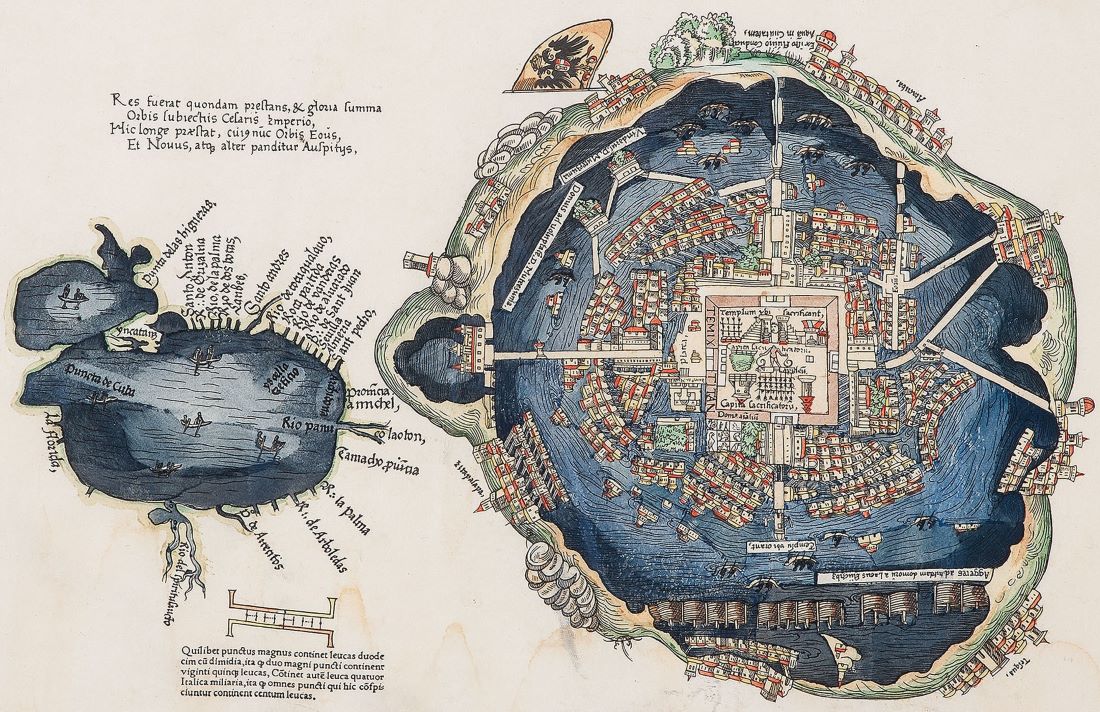
Tenochtitlan occupied an extraordinary position in the Valley of Mexico. Built on islands in Lake Texcoco, the Aztec capital was surrounded by water and connected to the mainland through a system of raised causeways. Beyond the city itself, settlements stretched across the lake and its shores, creating an extensive urban landscape that must have appeared almost unimaginable to the approaching Spaniards.
The first sight of the capital left a particularly deep impression on Bernal Díaz del Castillo, one of Cortés’s soldiers, whose account remains among the most important eyewitness narratives of the conquest. Looking across the landscape, he struggled to describe what appeared before him:
“Gazing on such wonderful sights, we did not know what to say, or whether what appeared before us was real, for on one side, on the land, there were great cities, and in the lake ever so many more, and the lake itself was crowded with canoes, and in the Causeway there were many bridges at intervals, and in front of us stood the great City of Mexico, and we—we did not even number four hundred soldiers!”
The passage captures the sheer scale of the spectacle. The Spaniards were not looking at an isolated settlement surrounded by wilderness, but at a vast concentration of urban life. Cities and communities occupied the surrounding landscape, while countless canoes moved across the lake. Bridges and causeways connected different parts of this extraordinary environment, leading towards the imposing capital.
For Díaz and his companions, the experience was almost overwhelming. Their small force, numbering fewer than four hundred soldiers, stood before a metropolis whose scale and complexity seemed difficult to comprehend.
Magnificent Houses and Streets Built for Land and Water
The architecture of Tenochtitlan was another source of astonishment. Cortés observed that the city contained numerous large and impressive houses, many of them rising to two storeys. These were substantial buildings, often accompanied by carefully maintained gardens that added to the beauty of their surroundings.
Díaz was particularly impressed by their interiors and gardens, describing the residences as follows:
“in addition to having fine and large dwelling rooms, have very exquisite flower gardens.”
Such descriptions reveal a city whose architecture was not limited to monumental religious structures or the residences of its rulers. Even its domestic buildings demonstrated considerable craftsmanship and an appreciation for spacious living environments. Gardens, flowers, and carefully designed houses contributed to an urban landscape that impressed the Spanish visitors.
The streets were equally remarkable. One contemporary description emphasised their width and appearance, noting that the city possessed numerous handsome thoroughfares, with several principal streets crossing its urban centre. Some sections consisted of solid, paved ground, while others incorporated waterways that allowed boats to move through the city.
One member of the Spanish expedition described this unusual arrangement:
“many wide and handsome streets; of these two or three are the principal streets, and the others are formed half of hard earth like a brick pavement, and the other half of water, so that they can go along on land or by water by the boats which are made of hollowed wood…”
This description illustrates how closely Tenochtitlan’s urban organisation was connected to its aquatic environment. Its inhabitants could travel along streets on foot or use boats to navigate the waterways. Canals were not simply decorative features but an essential part of everyday transportation and the city’s functioning.
For the Spanish sailors, the numerous waterways brought to mind Venice, one of Europe’s most recognisable cities. The comparison was particularly striking: just as Venice had developed an urban identity shaped by its canals, Tenochtitlan had incorporated water into almost every aspect of its metropolitan life.
A Marketplace Greater Than Rome’s
Among the many features of Tenochtitlan, its great marketplace made an especially powerful impression on the Spanish soldiers. They were accustomed to the commercial centres of Europe, yet the scale and organisation of the Aztec marketplace surpassed their expectations.
According to the account preserved by Lavery, the soldiers considered the great marketplace larger and better regulated than that of Rome. This was an extraordinary comparison. Rome represented one of the greatest urban centres in European historical imagination, and its commercial traditions were familiar to the Spanish visitors.
To find a marketplace that appeared even larger and more efficiently organised was therefore a remarkable experience.
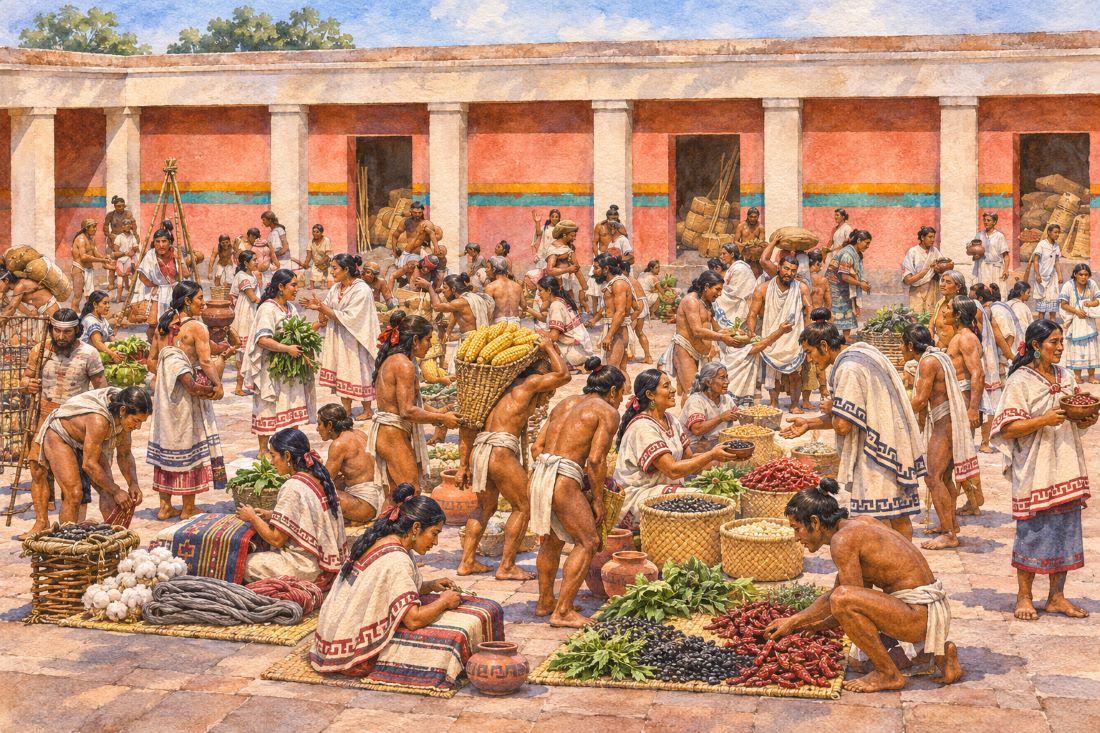
The marketplace also revealed the economic importance of Tenochtitlan. The capital was not merely the political and religious centre of the Aztec Empire; it was also the focal point of an extensive commercial network. Its prosperity depended on the movement of goods, merchants, and visitors from different parts of the empire.
The Spanish had travelled across the Atlantic in search of wealth, expecting to find precious metals and opportunities for conquest. In Tenochtitlan, however, they encountered a commercial world whose scale and organisation were impressive in their own right.
The Great Temple: Monumentality at the Heart of the City
Dominating the religious landscape of Tenochtitlan was its enormous ceremonial temple, one of the most imposing structures in the capital. Its elevated platform and monumental staircase made it a defining feature of the city’s skyline.
Cortés climbed the temple’s 114 steps, refusing assistance to demonstrate that he and his companions were not easily exhausted. From the summit, he could observe the surrounding city, while the temple itself offered a striking expression of the religious and political authority of the Aztec rulers.
However, the experience also exposed the Spanish visitors to religious practices that deeply disturbed them. At the summit, they witnessed human sacrifices. Díaz described the scene in particularly graphic terms:
“they were burning the hearts of the three Indians whom they had sacrificed that day. All the walls of the oratory were so splashed and encrusted with blood that they were black, the floor was the same and the whole place stank.”
The description reveals the contrast between the architectural magnificence of Tenochtitlan and the horror with which the Spanish regarded certain aspects of Aztec religious life. Their accounts combined genuine admiration for the city’s achievements with the religious and cultural prejudices of sixteenth-century Europeans.
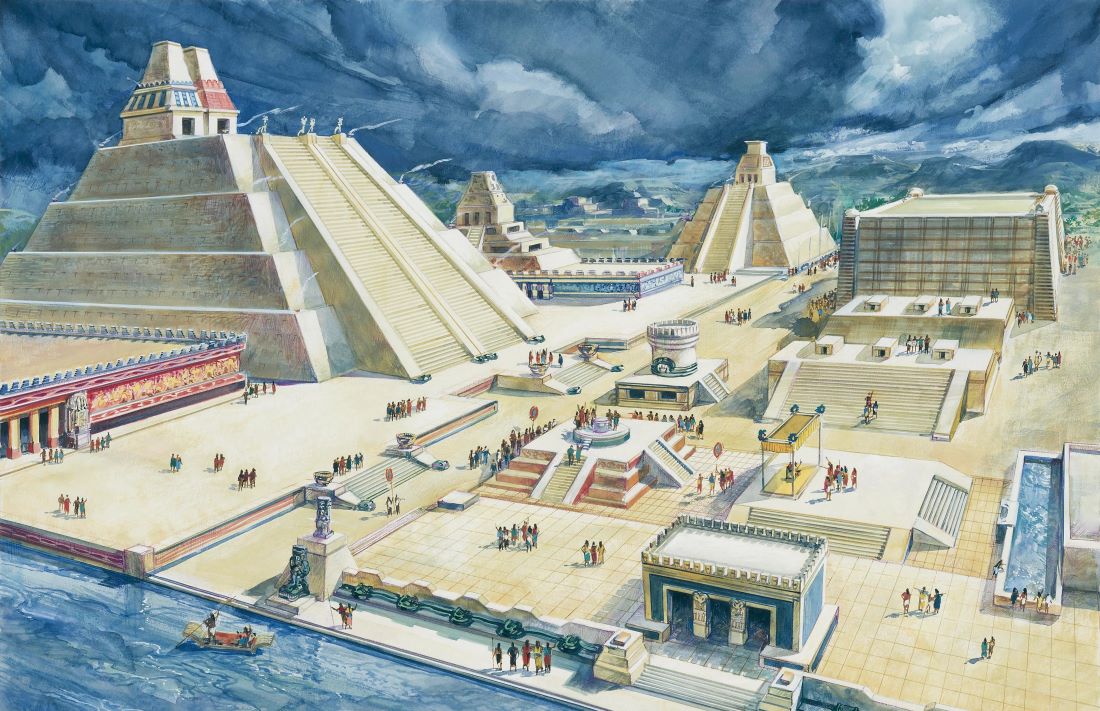
Nevertheless, the great temple remained one of the most memorable features of the capital, its monumental presence reflecting the central role of religion in Aztec society.
A City That Challenged European Expectations
The first Spanish descriptions of Tenochtitlan are remarkable not simply because they record the appearance of an unfamiliar city, but because they reveal how profoundly its existence challenged European expectations.
The comparisons with Rome and Venice are particularly revealing. The Spaniards used familiar European cities to communicate the scale and character of what they had encountered. Venice helped them explain the extraordinary network of waterways, while Rome provided a reference point for measuring the size and organisation of the marketplace.
Yet Tenochtitlan was not simply an American version of either city. It possessed its own distinctive urban character, shaped by the geography of Lake Texcoco and the engineering achievements of its inhabitants.
Its construction was all the more remarkable considering that the Aztecs did not possess iron tools, horses, or wheeled transport. Nevertheless, they had developed a sophisticated capital with substantial buildings, extensive waterways, impressive causeways, and an urban infrastructure capable of supporting a large population.
The city was the political heart of an expanding empire ruled by Moctezuma II, and its architecture and commercial activity reflected the resources and authority concentrated there.
For Cortés and his men, the discovery was both an opportunity and a challenge. They had reached the centre of a powerful empire whose wealth they hoped to seize, but they had also encountered a civilisation whose urban achievements were impossible to dismiss.
When the Spanish entered Tenochtitlan in November 1519, they were welcomed by Moctezuma himself. Yet the extraordinary capital they had admired would soon become the centre of a devastating struggle. Following rebellion, warfare, and an eighty-five-day siege, Tenochtitlan finally fell to the Spanish and their indigenous allies on 13 August 1521.
The city was subsequently destroyed and Mexico City was established upon its ruins. Its political and religious institutions disappeared, but the descriptions left by those who first encountered it preserve the memory of one of the most remarkable urban centres of the pre-Columbian Americas.
For the men who approached it in 1519, Tenochtitlan was a sight almost beyond belief: a magnificent metropolis of temples, palaces, gardens, marketplaces, canals, and causeways, rising from the waters of a great lake. Even the conquistadors who came to conquer it could not hide their astonishment at what stood before them.
Currently Reading
-
 Historical Atlas of the Holy Lands
Maps of the region’s places, peoples and changing borders.
-
 The Historical Atlas of Native Americans
Indigenous nations and their histories across North America.
What to Read Next
El Dorado: Myth, Madness, and the Eternal Allure of a Lost Golden City
For nearly 500 years, the legend of El Dorado has captivated the Western imagination. A city, or sometimes a king, so rich that its…
The Orient Express: Europe’s Legendary Train of Intrigue, Luxury, and Legend
For more than a century, the name Orient Express has evoked images of luxury, mystery, and romance. Elegant wood-paneled carriages, crystal chandeliers, fine dining,…
The Laki Volcanic Eruption and the French Revolution
The French Revolution is traditionally explained through political, social, and economic factors: unsustainable royal debt, an unfair tax system, the privileges of the nobility…