
 By istorija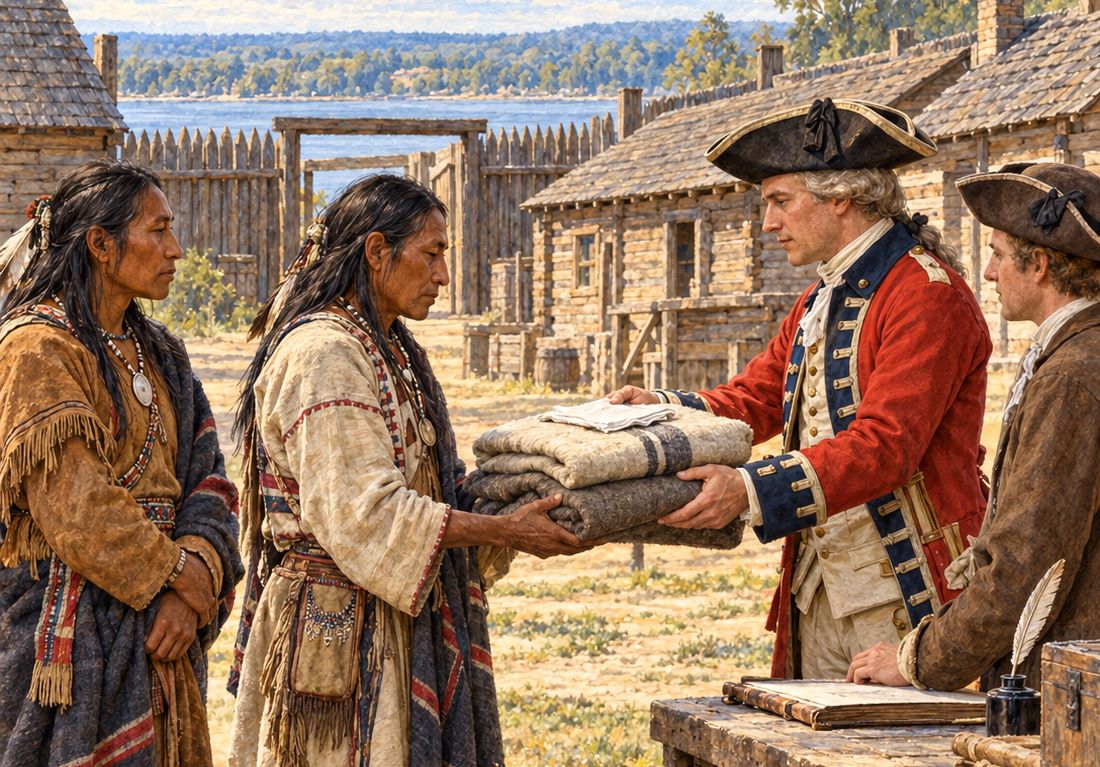
In the summer of 1763, British officers faced an Indigenous uprising threatening their control of North America’s western frontier. Their response included a chilling proposal: use smallpox, one of the deadliest diseases of the age, against the people resisting British rule.
At Fort Pitt, two Delaware representatives received blankets and a handkerchief from a hospital treating smallpox patients. The officer who recorded the transaction expressed hope that the items would have the “desired effect.” The incident is one of the best-documented attempts to use disease as a weapon in eighteenth-century North America. But did it work, and how did it fit into the wider struggle known as Pontiac’s War?
Why Pontiac’s War Began
The Treaty of Paris, signed in February 1763, ended the Seven Years’ War and transferred France’s former territories in mainland North America east of the Mississippi to Britain, with the exception of New Orleans. For Indigenous nations across the Great Lakes and Ohio country, however, the transfer threatened their political independence and territorial security.
During the war against France, British officials had cultivated Indigenous alliances through gifts, trade, and diplomacy. After Britain secured victory, General Jeffery Amherst, commander of British forces in North America, reduced the distribution of gifts and restricted the supply of ammunition and other goods. British traders often charged high prices, while colonial settlers continued moving onto Indigenous lands.
These policies strained relationships on which British authority in the interior depended. Indigenous resistance was not simply a reaction to lost trading privileges. It was also a struggle over land, sovereignty, and the right of Indigenous nations to determine their own future.
Pontiac, an Ottawa war leader, became one of the most prominent figures in the uprising. The spiritual teachings of Neolin, a Delaware religious leader, also encouraged Indigenous peoples to reject European influence and renew their traditional ways of life. Yet the resistance was not a single, centrally controlled movement: different nations and communities pursued their own interests while confronting a common threat.
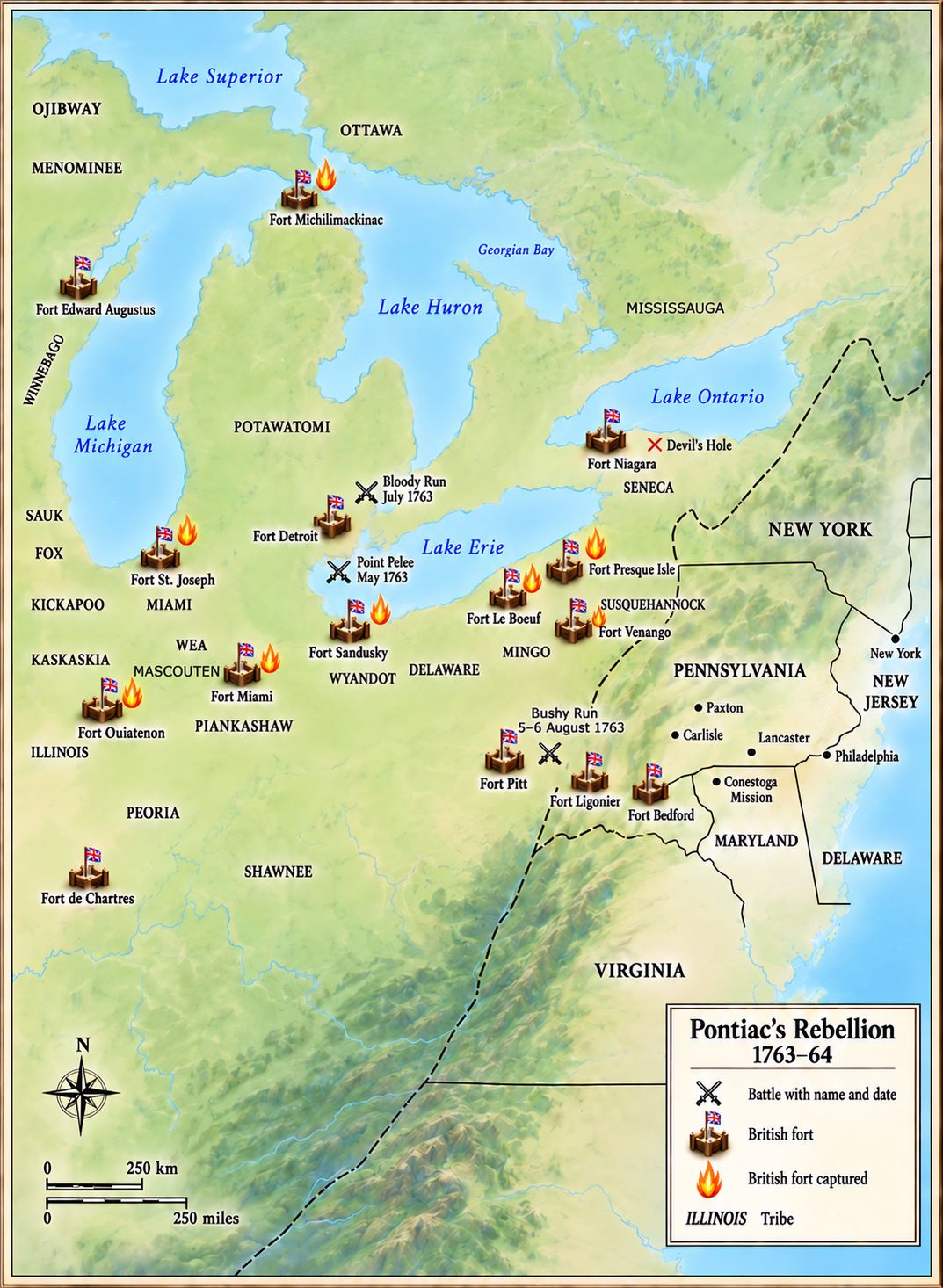
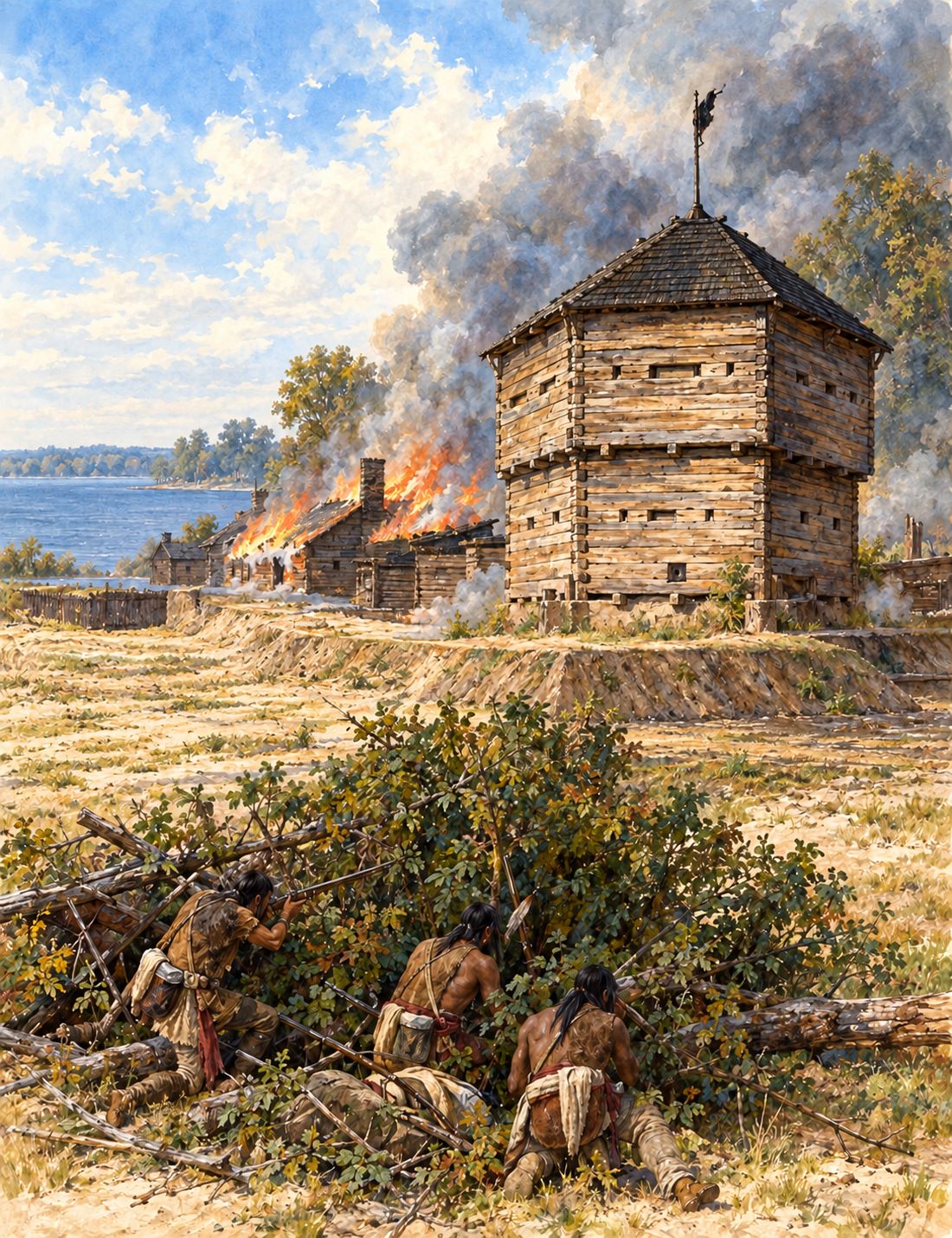
In the spring of 1763, Indigenous warriors attacked British forts across the Great Lakes and Ohio country. Several outposts fell, and Pontiac’s forces laid siege to Detroit. Fort Pitt, in present-day Pittsburgh, also came under attack. Britain’s victory over France had failed to secure the interior; instead, the empire faced a widespread resistance movement.
The Fort Pitt Smallpox Plot
By June 1763, smallpox was present among the British garrison at Fort Pitt. The disease caused fever and severe skin eruptions, left many survivors scarred, and killed a substantial proportion of those infected. In communities with little or no previous exposure, outbreaks could be especially devastating.
On June 24, two Delaware representatives met with British officials at the besieged fort. During the encounter, they received two blankets and a handkerchief taken from the smallpox hospital. William Trent, a trader and militia officer, recorded the transaction in his journal:
“Out of our regard to them, we gave them two Blankets and an Handkerchief out of the Small Pox Hospital. I hope it will have the desired effect.”
The remark leaves little doubt about the intended purpose. A separate account submitted for reimbursement also described the items as having been supplied in an attempt to spread smallpox among Indigenous people. This was not merely a later legend: contemporary documents record a deliberate attempt to transmit the disease.
The episode was followed by an even more explicit exchange between senior British officers. In July, Amherst proposed spreading smallpox among Indigenous opponents in correspondence with Colonel Henry Bouquet. Bouquet responded that he would try to infect them using blankets, and Amherst approved the idea.
There is, however, an important chronological distinction. The Fort Pitt transaction took place in June, before the surviving Amherst–Bouquet correspondence on the subject. The documents do not establish that Amherst personally ordered the original distribution. They do show that the attempt at Fort Pitt was deliberate and that senior commanders subsequently discussed and endorsed the use of disease.
The distinction matters for historical accuracy, but it does not diminish the significance of the episode.
Did the Blankets Spread Smallpox?
Smallpox subsequently affected Indigenous communities in the region. In April 1764, a man who had escaped captivity among the Shawnee and Delaware reported that the disease had been widespread since the previous spring. Such accounts make the Fort Pitt incident particularly disturbing.
The idea was medically plausible. Smallpox could spread through contact with contaminated clothing or bedding, as well as through close contact with infected people. But the existence of a deliberate attempt does not prove that it caused a particular outbreak.
The disease was already present at Fort Pitt, and other routes of transmission were possible. The surviving evidence cannot establish how many people, if any, contracted smallpox from the blankets. Nor does it demonstrate that the incident decisively weakened the Delaware or other Indigenous nations, or forced them to make peace.
The distinction between intention and outcome is essential. The attempt to spread disease is documented; its precise consequences remain uncertain.
A War That Did Not End with the Epidemic
The smallpox plot did not bring Pontiac’s War to an immediate end. British forces continued fighting, and Indigenous resistance remained formidable. In August 1763, Bouquet’s relief expedition fought a costly battle at Bushy Run, helping secure the route to Fort Pitt. Detroit, meanwhile, withstood a prolonged siege before Pontiac eventually withdrew.
Over the following years, military pressure, divisions among Indigenous communities, and the difficulties of sustaining a prolonged campaign contributed to the decline of the wider resistance. Some leaders negotiated peace, while others continued to oppose British expansion. Pontiac himself reached an agreement with the British in 1766.
The conflict nevertheless forced Britain to reconsider its western policy. The Royal Proclamation of 1763 attempted to restrict colonial settlement beyond the Appalachian Mountains and establish a boundary between colonial settlements and Indigenous territories. It did not stop settler expansion, but it reflected the British government’s recognition that military victory alone could not guarantee stability on the frontier.
The Legacy of Fort Pitt
The Fort Pitt incident reveals how far some British officials were willing to go to suppress Indigenous resistance. Their correspondence and contemporary records document the deliberate consideration and attempted use of smallpox as a weapon. Yet the episode should not be reduced to a claim that infected blankets decided the outcome of Pontiac’s War. The evidence does not support that conclusion.
Indigenous nations had risen against a new imperial order that threatened their lands, alliances, and political independence. They challenged British power across a vast region, even as warfare, disease, and colonial expansion placed their communities under immense pressure.
The blankets from Fort Pitt remain a chilling historical record of an attempt to turn disease into a weapon. Their significance lies not in an unproven claim that they won the war, but in what the documents reveal about the methods British officers were prepared to consider in their struggle to control Indigenous lands.
Currently Reading

Historical Challenge: Can You Conquer the Past?
Answer more than 18 questions correctly, and you will win a copy of History Chronicles Magazine Vol 1! Take our interactive history quiz now and put your knowledge to the test!