
 By istorija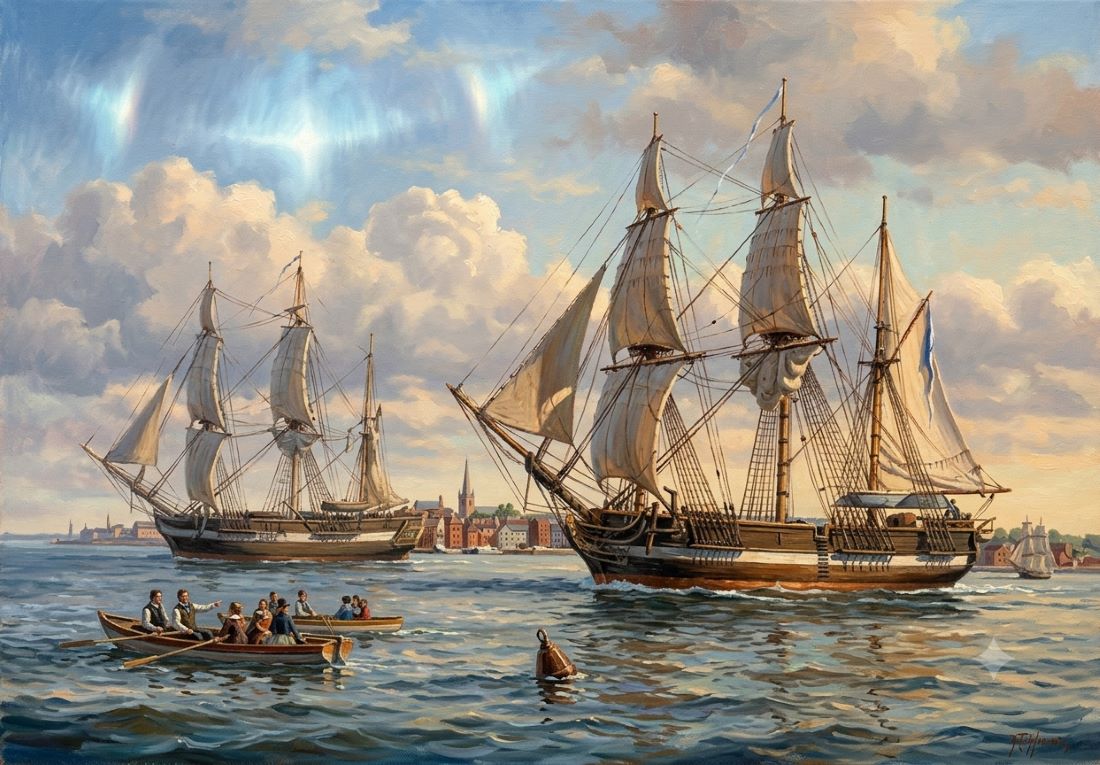
In May 1845, two majestic ships sailed out of Greenhithe, England, framed by cheering crowds and national pride. British newspapers hailed it as the finest, most unbeatable Arctic expedition ever assembled. Led by Sir John Franklin, a beloved veteran explorer, HMS Erebus and HMS Terror carried 129 men into the frozen unknown. Their mission was ambitious: map the final unnavigated section of the Northwest Passage—a lucrative trade route connecting the Atlantic and Pacific Oceans.
They were never seen alive by Europeans again.
For nearly 170 years, the complete disappearance of the Franklin expedition was one of history’s greatest unsolved mysteries. Sensational tales of madness, lead poisoning, and sudden catastrophe dominated the public imagination. But recent sub-sea archaeological discoveries and Indigenous oral histories have finally pieced together the puzzle.
The true story of HMS Erebus and Terror is not a simple gothic horror story—it is a heartbreaking narrative of human endurance colliding with the unforgiving power of nature.
The Technological Marvel That Met the Ice
To the British public, failure was unthinkable. Sir John Franklin was not merely embarking on a voyage; he was leading an industrial display of the British Empire’s triumph over nature. The Admiralty had spared no expense in fortifying both vessels.
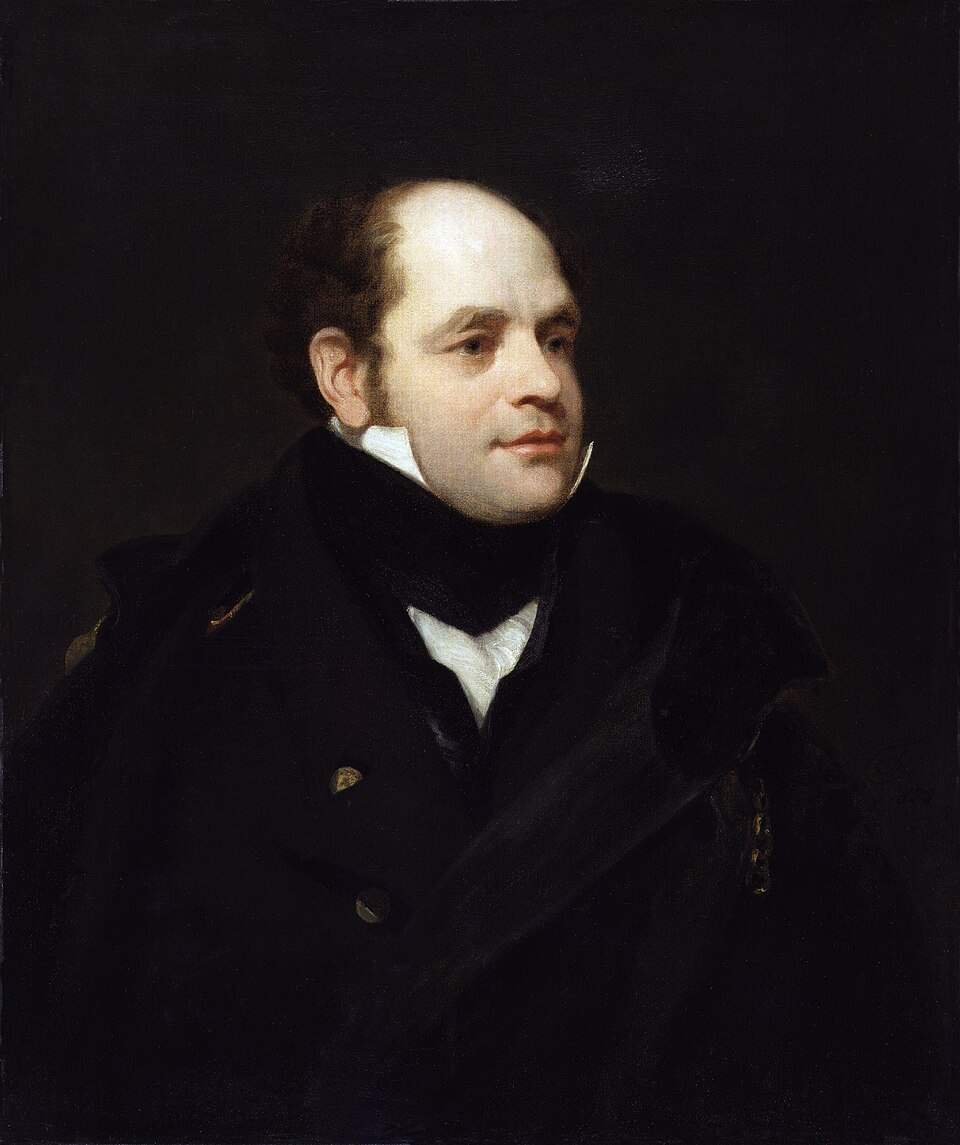
    [ THE HIGH-TECH SHIPWRECKS OF 1845 ]

    Iron-Reinforced Hulls   ===> Built to withstand thousands of tons of crushing ice.
    Converted Locomotive Engines ===> Gave the ships independent steam propulsion.
    Desalination Systems   ===> Provided fresh drinking water directly from seawater.
The ships were packed with over 8,000 tins of preserved food, a cutting-edge invention meant to prevent scurvy during long polar winters. Young officers like Commander James Fitzjames wrote home with supreme confidence, marveling at the luxury and warmth inside the oak-paneled cabins.
Yet, no amount of Victorian steam power could overcome the relentless grip of the northern ice.
Trapped in the Ice: The Fatal Trap at King William Island
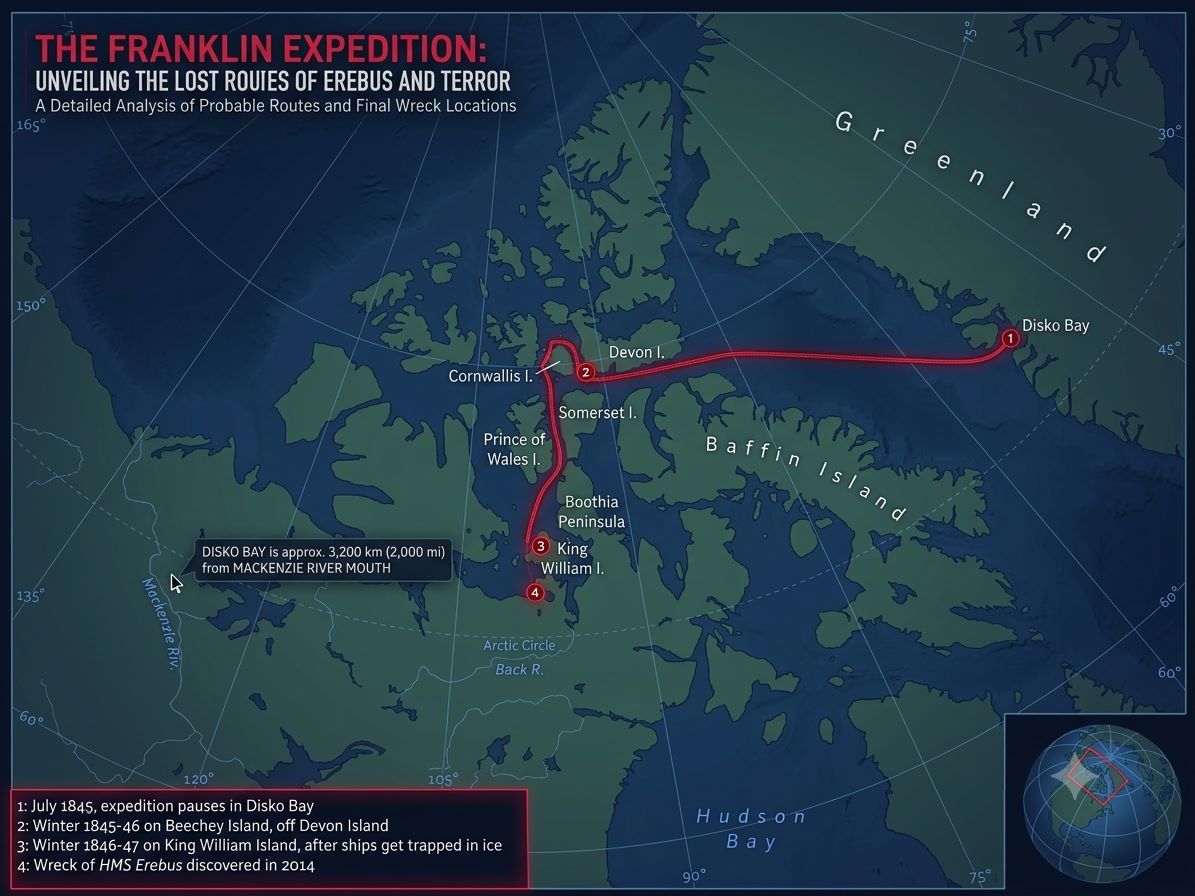
In the summer of 1846, after navigating around Cornwallis Island, Franklin made a fateful decision. He pointed his ships south toward King William Island, unaware that this specific passage acted as a natural funnel for thick, multi-year pack ice flowing down from the Arctic Ocean.
In September 1846, both ships ground to a halt, hopelessly frozen in place north of the island.
Inside the wooden hulls, the environment became a living nightmare. As temperatures plummeted past -40°C, the ice squeezed the ships with the weight of thousands of tons. Sailors described the deafening sound of iron and oak groaning under constant pressure, while frost formed inches thick on the interior walls.
The expedition expected the ice to break apart during the summer of 1847. It never did. Paleoclimatic data suggests the late 1840s experienced severe icy conditions in that region, keeping the sea locked in a solid, frozen sheet.
On June 11, 1847, Sir John Franklin died aboard HMS Erebus. Command fell to Captain Francis Crozier—a brilliant, battle-tested navigator who now faced an escalating catastrophe.
The Victory Point Note: A Message from the Frozen Void
For eleven long years, the Arctic kept its secret. Search parties sent by the Admiralty found nothing but empty tundra.
Then, in 1859, a search vessel funded by Franklin’s grieving widow, Lady Jane Franklin, made a dramatic discovery. On the desolate coast of King William Island, Lieutenant William Hobson found a stone cairn containing a single tin cylinder. Inside was the Victory Point Note—the only written record ever recovered from the expedition.
The paper told two stories, written months apart.
The first entry, optimistic and neat:
“May 28, 1847: HMS Erebus and Terror wintered in the ice… Sir John Franklin commanding. All well.”
Scrawled frantically around the margins of that same paper, dated April 25, 1848, was a second, chilling message:
“April 25, 1848: HMS Erebus and Terror were deserted on April 22… 9 officers and 15 men have died. Sir John Franklin died on June 11, 1847… Start tomorrow for Backs River.” — Captain Francis Crozier & Captain James Fitzjames
    [ THE DISASTER TIMELINE ]

    May 1845: Departed England (129 Men)  ===>  Sept 1846: Trapped in Ice  ===>
    June 1847: Sir John Franklin Dies     ===>  April 1848: Ships Abandoned (105 Men left)
105 exhausted men, suffering from severe malnutrition, scurvy, and respiratory illness, stepped onto the barren ice. They began dragging heavy wooden lifeboats mounted on sledges toward a distant trading post hundreds of miles away.
Not a single officer or crewman completed the march.
Re-evaluating the Lead Poisoning Theory
For decades, popular history pointed to a single, sensational villain: lead poisoning from defective tinned food. In the 1980s, forensic exhumations of three preserved crewmen on Beechey Island revealed elevated lead levels, fueling theories that the crew suffered from madness and physical collapse caused by toxic cans.
Modern historical and scientific research offers a more nuanced view.
Subsequent elemental analyses of bones across the broader crew show that while lead exposure was present, it was fairly typical for citizens of 19th-century industrial Britain, where lead piping, pewter cookware, and tinned goods were common. While lead toxicity may have been a contributing stressor, researchers now agree it was not the primary engine of the disaster.
    [ PRIMART DRIVERS OF MORTALITY ]

    1. Systemic Starvation   ===> Extreme caloric deficit over months of heavy manual labor.
    2. Advanced Scurvy       ===> Severe Vitamin C deficiency leading to internal bleeding.
    3. Exposure & Disease    ===> Tuberculosis and pneumonia in sub-zero shelter conditions.
The men did not perish because of a single manufacturing defect; they succumbed to systemic exhaustion, harsh weather, and multi-year starvation in an environment that offered no wild game to sustain over 100 people.
The Breakthrough: Inuit Knowledge Solves the Mystery
For over a century, European searchers overlooked the most valuable eyewitnesses in the region: the local Inuit.
Inuit oral tradition held exact details about the fate of Franklin’s men for generations. Hunters told stories of starving, weakened men pulling heavy sledges, finding camps marked by desperate survival cannibalism, and witnessing one of the ships drifting south and sinking into the sea.
“There was a ship that sank in deep water… long ago, our elders saw the top of its mast sticking out of the ice.” — Inuit Oral History passed to Louie Kamookak
Regrettably, 19th-century authorities dismissed these accounts as unreliable folklore. It was not until Inuit historian Louie Kamookak spent decades working alongside Parks Canada—combining Indigenous knowledge with nautical mapping—that the search pivoted.
In 2014, underwater archaeologists following Inuit directions located the wreck of HMS Erebus in Wilmot and Crampton Bay. Two years later, in 2016, the wreck of HMS Terror was discovered in Terror Bay.
The ships rested upright on the sea floor under icy water, their hulls intact, glass windowpanes unbroken, and artifacts preserved in near-perfect condition.
Frequently Asked Questions (FAQ)
Did the crew of the Franklin Expedition resort to cannibalism?
Yes. Forensic studies on human remains recovered from King William Island show distinct cut marks and bone fractures consistent with late-stage survival cannibalism. These findings align directly with 19th-century Inuit testimony.
Why was HMS Terror found so far south of where it was abandoned?
The location of HMS Terror in Terror Bay remains an active area of study. The leading archaeological hypothesis suggests that after the initial evacuation in 1848, a surviving group may have returned to the ship during a temporary thaw in a desperate attempt to maneuver it further south.
What caused Sir John Franklin’s death?
Sir John Franklin died on June 11, 1847, nearly a year before the crew abandoned the ships. Because he died prior to the onset of extreme starvation, historians suspect natural causes, such as a heart attack, stroke, or acute illness.
Conclusion: Lessons Written in the Ice
The ultimate resolution of Sir John Franklin’s lost expedition was achieved not through modern technology alone, but by honoring centuries of Indigenous memory alongside marine archaeology.
The pristine wrecks resting at the bottom of the icy waters stand as silent monuments to an era of unyielding ambition. Franklin’s crew members were not victims of madness or simple miscalculation; they were trapped in an uncompromising wilderness, fighting for survival against impossible odds.
Victorian Britain sent machines to conquer the Arctic. The Arctic preserved the truth to humble history.
Currently Reading


Historical Challenge: Can You Conquer the Past?
Answer more than 18 questions correctly, and you will win a copy of History Chronicles Magazine Vol 1! Take our interactive history quiz now and put your knowledge to the test!