
 By istorija
The question “How Did World War I Start?” has captivated researchers for over a hundred years.”This inquiry delves into a complex tangle of alliances, political maneuverings, and escalating tensions that have shaped our modern world. The answers continue to be debated among scholars and historians, underscoring the profound impact of this global conflict.
Alliances and Rivalries: The Precursors of World War I
In the years leading up to the First World War, the political and military landscape of Europe was dominated by two major alliances, the Triple Entente and the Central Powers.
The Triple Entente consisted of France, Russia, and the United Kingdom, formed out of a series of treaties starting in 1894 with the Franco-Russian Alliance. The objective was to counterbalance the perceived threat of the Central Powers, primarily constituted by Germany, Austria-Hungary, and Italy, bonded by the Triple Alliance in 1882.
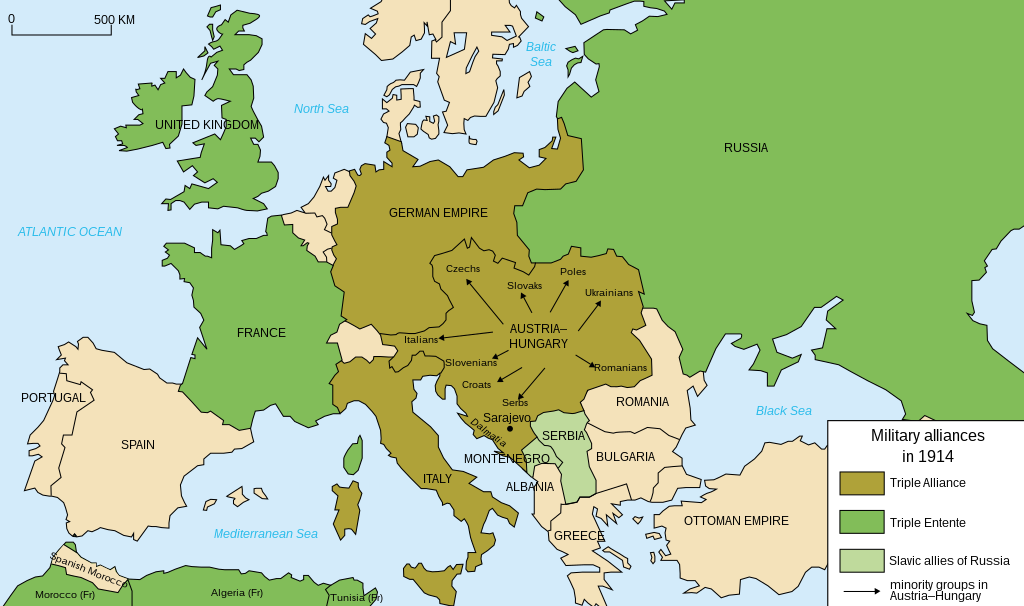
In the background of these alliances was a grand struggle for colonial territories, particularly in Africa and Asia. The Scramble for Africa from 1881 to 1914 showcased Europe’s imperialistic ambitions, causing tensions amongst the powers. The Anglo-German Naval Race exemplified the rivalry between Britain and Germany. Germany’s determination to match Britain’s naval supremacy led to an arms race, escalating tensions further.
Germany and Austria-Hungary were driven by their desire to protect their spheres of influence in Europe. Germany, under the leadership of Kaiser Wilhelm II, was rapidly industrializing and sought to expand its colonial possessions. Austria-Hungary aimed to preserve its declining empire against the rising nationalistic movements.
The Entente powers, on the other hand, had a shared interest in curbing the Central Powers’ expansion. Russia was wary of the Austro-Hungarian influence in the Balkans, a region Russia considered under its protection. France sought to avenge its defeat in the Franco-Prussian War and regain its lost territories. The United Kingdom, having established the most extensive empire, was primarily concerned about maintaining the balance of power in Europe.
These alliances, set against a backdrop of rising nationalism and shifting power balances, ultimately led to the catastrophe of World War I.
International Crises: Further Strains and the Path to War
The First Moroccan Crisis (1905-1906) arose when Germany, under Kaiser Wilhelm II, decided to challenge French influence in Morocco, which France had designs on. The crisis heightened Franco-German antagonism and led to the Algeciras Conference in 1906 where Germany’s attempt to isolate France failed, solidifying the alignment of Britain and France against German imperialism.
In contrast, the Second Moroccan Crisis (1911), also known as the Agadir Crisis, was marked by Germany sending the gunboat “Panther” to the Moroccan port of Agadir, again aiming to challenge French influence. This incident further isolated Germany and led to an Anglo-French accord, with Britain supporting French control over Morocco while France acquiesced to British influence in Egypt.
Finally, the Balkan Wars (1912-1913) put the spotlight on the Balkans’ volatility. The first Balkan War saw the Balkan League (Serbia, Greece, Bulgaria, and Montenegro) defeating the Ottoman Empire, expelling it from most of Europe. The second war resulted from territorial disputes among the allies themselves. These wars destabilized the region, strengthening Serbia while weakening Austria-Hungary’s influence.
Each crisis further strained the existing alliances and rivalries. They served to heighten the militaristic attitudes and aggressive nationalism that was brewing across Europe. This volatile mix of heightened nationalism, imperialistic rivalries, and the tangled web of alliances and counter-alliances, set the stage for the outbreak of World War I.
A Trigger for War: The Annexation of Bosnia and Herzegovina and Assassination of Archduke Franz Ferdinand
The annexation of Bosnia and Herzegovina by Austria-Hungary in 1908 marked a significant turning point in the prelude to the First World War. The annexation disregarded the Treaty of Berlin (1878), which allowed Austria-Hungary to administer the provinces but not to annex them, thereby stoking tensions with Serbia and Russia.
Austro-Hungarian policy in Bosnia and Herzegovina was aimed at solidifying its control over the region and countering the rise of South Slav nationalism. However, these actions spurred the formation of revolutionary groups, such as Young Bosnia (Mlada Bosna), composed of Serbian, Muslim, and Croat nationalists. Their shared vision was the liberation of all South Slavs from Austro-Hungarian rule.
The most notorious act associated with Young Bosnia was the assassination of Archduke Franz Ferdinand of Austria, heir to the Austro-Hungarian throne, on June 28, 1914, in Sarajevo. The assassin, Gavrilo Princip, a Bosnian Serb member of Young Bosnia, saw Ferdinand as a symbol of the oppressive rule that needed to be uprooted.
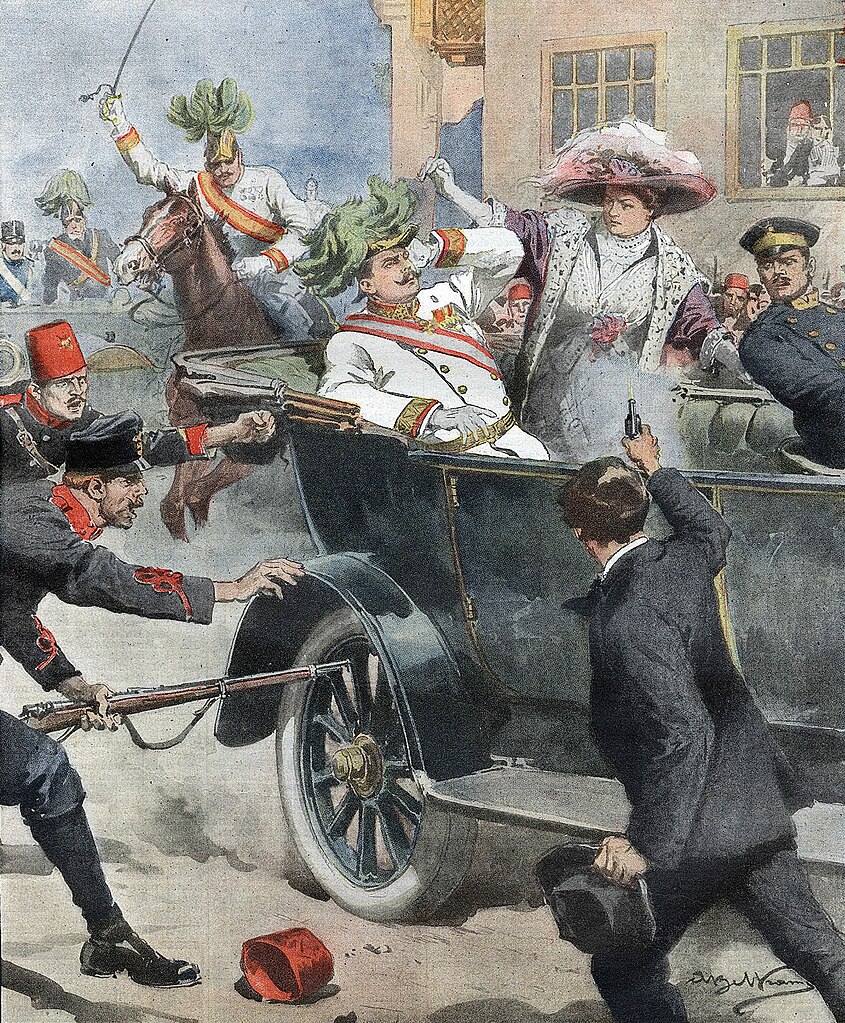
Historiographically, the interpretation of this act varies. While some see it as an act of terrorism, others interpret it as tyrannicide, given the oppressive Austro-Hungarian policies in Bosnia and Herzegovina. Regardless of the viewpoint, it’s crucial to recognize that while this event is often cited as the immediate trigger for World War I, it was not the root cause. The assassination was a spark that ignited the conflict, but the kindling had been laid by the series of political, imperial, and military rivalries, and crises we discussed earlier.
The events leading to the war were intricate and interconnected, with the assassination of Franz Ferdinand serving as the final catalyst in a chain of escalating tensions, leading to the cataclysm of World War I. In conclusion, the factors contributing to the war’s outbreak were manifold and deeply embedded in the political and social fabric of the period.
Currently Reading
Historical Challenge: Can You Conquer the Past?
Answer more than 18 questions correctly, and you will win a copy of History Chronicles Magazine Vol 1! Take our interactive history quiz now and put your knowledge to the test!